
15.10.2026 à 16:55
Lecture : où sont les hommes ?
Claude Poissenot, Enseignant-chercheur à l'IUT Nancy-Charlemagne et au Centre de REcherches sur les Médiations (CREM), Université de Lorraine
Texte intégral (2290 mots)
L’ESSENTIEL
Dans les discours de déploration sur la lecture, les jeunes font figure de cibles privilégiées.
Pourtant, il est une autre catégorie qui se distingue par des pratiques de lecture en berne : les hommes.
Comment expliquer ce désinvestissement ? Et pourquoi les femmes s’intéressent-elles bien davantage à la lecture ?
Un rapport de l’Inspection générale de l’éducation, du sport et de la recherche, publié en octobre 2025, fait le point sur les études montrant la faiblesse des performances des garçons en lecture par rapport aux filles.
Et l’enquête PISA récemment publiée confirme la faiblesse du niveau de compréhension de l’écrit des garçons de 15 ans par rapport aux filles de même âge. Notons que ce résultat vaut pour les 38 pays de l’OCDE. Et quand on observe les pratiques de lecture de loisirs des jeunes Français dans l’enquête du Centre national du livre (CNL) de 2026, on constate une baisse entre 7 ans et 19 ans, mais qui touche encore plus les garçons que les filles.
Cette situation se prolonge après le temps de la jeunesse. Si, bien sûr, il existe des hommes lecteurs, dans l’enquête CNL de 2025 sur les 15 ans et plus, ceux-ci se définissent moins que les femmes comme lisant beaucoup, ils ont moins souvent lu au moins un genre de livre, disent nettement moins lire tous les jours et déclarent un nombre de livres lus moins élevé.
Cet écart n’est pas nouveau puisqu’il avait déjà été repéré par l’enquête Pratiques culturelles des Français de 1988. Mais il s’est approfondi depuis : entre 1988 et 2018, la part de lecteurs parmi les hommes a baissé de 27 % (71 % en 1988 contre 52 % en 2018) et celle des lecteurs intensifs (20 livres et plus par an) de 50 % alors que les évolutions sont respectivement de – 8 % et – 21 % chez les femmes. De leur côté, les données du CNL établissent la persistance voire l’accroissement de cet écart entre 2018 et 2025.
Qu’est-ce qui alimente l’attrait de la lecture pour les femmes ?
Est-ce la socialisation de genre qui pousse les femmes à se construire grâce à la lecture ? Les sociologues Gérard Mauger et Claude F. Poliak reprennent le découpage proposé par le sociologue Émile Durkheim entre « monde des choses matérielles » et « monde humain ». Le premier est socialement assigné aux hommes tandis que le second l’est aux femmes. Et il est vrai que, même si l’on note certaines évolutions, dans le monde professionnel, on trouve davantage de femmes dans les métiers du care et davantage d’hommes dans ceux de la production (industrie, construction, etc.).
Au sein du foyer, la même répartition s’observe toujours aujourd’hui avec les hommes davantage consacrés à l’entretien de la maison, de la voiture ou du jardin et les femmes assignées à la prise en charge matérielle et éducative des enfants ou au soin des parents âgés. Cette structuration du monde façonne celle de la lecture, selon les deux sociologues.
Les femmes, plus socialisées à se préoccuper des autres, acquièrent tôt des compétences et des expériences dans la prise en charge des relations humaines. Les romans (qu’elles lisent nettement plus que les hommes dès l’adolescence : 55 % contre 39 % chez les 7-19 ans) y contribuent, les confrontant à des situations, des émotions, des relations et des enjeux qu’elles peuvent rencontrer au quotidien. En quelque sorte, elles auraient de l’intérêt pour la lecture, car elles y auraient intérêt.
Cette interprétation est intéressante, mais n’est pas exclusive d’une autre. La féminisation de la lecture peut aussi être vue comme le produit de la revendication d’un ordre social renouvelé. Les femmes ont porté l’émergence de la deuxième modernité c’est-à-dire le passage d’une société d’individus abstraits à une société d’individus concrets et autonomes. Des individus qui ne veulent pas être réduits à des statuts. Par exemple, dans la famille se nouent des liens personnels, et cela se voit dans la préparation des repas où celle ou celui qui s’en charge prend en compte (au moins en partie) les goûts (et dégoûts) de chacun.
Les vagues féministes ont exprimé et revendiqué cette aspiration. Plutôt que d’être réduites au statut d’épouses et/ou de mères, elles ont revendiqué (et obtenu) d’être définies comme des personnes avec leurs propres avis, envies, sensibilités, activités, relations, etc. Même si de nombreux combats de fond restent à mener – entre autres sur les inégalités économiques, la lutte contre les violences sexistes et sexuelles – la lecture, comme l’écriture d’ailleurs, était et reste une alliée des femmes, autant dans l’affirmation de leur autonomie que dans la diffusion de leurs combats.
D’abord, elle forme une compétence nécessaire à la réussite scolaire et donc à l’accès au marché du travail. Les filles en prennent tôt conscience : à partir de 1965, elles obtiennent systématiquement de meilleurs résultats que les garçons. Elles ont sans doute été sensibilisées par les femmes de leur entourage (et leurs mères en particulier, dont on sait qu’elles jouent un rôle plus important dans l’éducation et la transmission de la lecture que les pères).
La lecture apparaît ensuite comme un point d’appui dans ce mouvement d’émancipation. Elle leur permet de fabriquer et de maintenir un monde qui leur est propre y compris imaginaire. La lecture constitue aussi une échappatoire à la vie ordinaire.
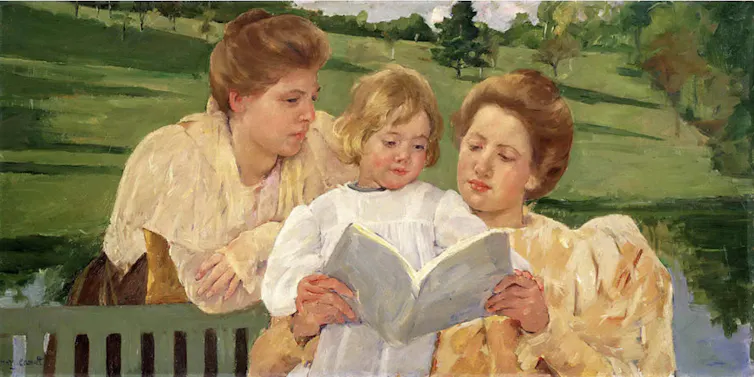
Lire, c’est aussi prendre du temps pour soi, et pour les femmes cela prend un sens particulier, car ce temps se situe en dehors des rôles de mère, d’épouse ou de travailleuse. Par ailleurs, les livres peuvent être synonymes d’émancipation et de sororité : la lecture est aussi un support de socialisation féminine. C’est bien sûr le cas des clubs de lecture, mais aussi des échanges entre amies ou entre mères et filles.
Enfin, le contenu même des livres peut porter des figures identificatoires attachées à leur liberté. Par exemple, le succès de la série Millénium (2005-2007) repose très probablement sur ce personnage féminin de Lisbeth Salander et sa capacité à répliquer aux situations de domination masculine.
Pourquoi les hommes lisent-ils moins ?
Pour les hommes, la pratique de la lecture semble a priori moins nécessaire pour faire face aux situations auxquelles ils sont aux prises dans le cadre professionnel.
L’orientation des élèves révèle très clairement ce partage genré des univers d’investissement. Pour le bac 2025, 59 % des garçons ont choisi la spécialité Mathématiques et 39 % la Physique-Chimie, et cette tendance s’est accentuée depuis 2021. Près de 30 % des garçons ont opté pour la combinaison Mathématiques, Physique-Chimie contre 15 % des filles. La lecture de livres n’apparaît donc pas comme au cœur des enjeux des hommes en formation. Et le domaine scientifique est socialement valorisé, dévaluant mécaniquement la pratique de la lecture.
Par ailleurs, l’identité masculine, telle qu’elle est classiquement définie dans le cadre d’une société patriarcale, accorde peu de place à la dimension relationnelle de l’existence et à la réflexivité sur le sujet. Les livres et leur capacité à fournir des expériences sur les rapports humains occupent dès lors une place moins importante. Pas étonnant alors que les hommes soient trois fois plus nombreux que les femmes à ne pas aimer du tout ou ne pas trop aimer lire (24 % contre 8 %) selon l’enquête CNL 2025.
Enfin, comme l’avait justement repéré la sociologue Sylvie Octobre, les femmes sont largement surreprésentées parmi le personnel en charge de la médiation du livre : enseignants du primaire puis de français, professeurs-documentalistes, bibliothécaires, libraires sont très majoritairement des femmes. Et c’est bien compréhensible, car elles trouvent probablement dans ces activités un prolongement d’un goût personnel – même si ce goût est socialement construit, comme nous l’avons vu plus haut.
Mais, en contrepartie, cela ne fait que conforter les garçons (futurs hommes) dans l’idée que la lecture relève davantage de la féminité que de la masculinité.
Être ensemble par la lecture
Parce que les livres nous donnent accès à des points de vue différents, ils augmentent notre capacité d’empathie. La fiction nous ouvre à l’altérité et donc aux relations humaines. On peut découvrir comment celle/celui qui n’est pas moi perçoit le monde ou le subit. La lectrice ou le lecteur devient un peu autre, et c’est ce qui lui permet de ne pas s’enfermer dans une identité aveugle à l’altérité. Elle est une fenêtre vers un universalisme concret.
En outre, par l’accès qu’elle fournit à un autre monde sensible, la lecture est indissociable de la réflexivité. On peut, grâce à elle, interroger sa manière d’être au monde et avec les autres. Cela fournit un temps de recul propice à l’apaisement et à la communication. Et la sociologie du couple a montré que les femmes, dans le cadre du couple hétérosexuel, aspirent à des relations conjugales nourries de ces échanges.
Enfin, la lecture des hommes constitue un enjeu collectif parce qu’elle permet de bâtir une « République des lecteurs » à la fois attentive aux autres, sensible à l’information vérifiée et à même de forger un récit commun.
Un monde de lecteurs autant que de lectrices serait donc sans doute profitable à toutes et à tous, à chacune et à chacun.

Claude Poissenot ne travaille pas, ne conseille pas, ne possède pas de parts, ne reçoit pas de fonds d'une organisation qui pourrait tirer profit de cet article, et n'a déclaré aucune autre affiliation que son organisme de recherche.
15.10.2026 à 16:55
Pour mieux taxer les plus riches, il est nécessaire de mieux définir le revenu
Guillaume Allègre, Économiste au département des études de l'OFCE, Sciences Po
Xavier Timbeau, Économiste à l'Observatoire français des conjonctures économiques (OFCE), Sciences Po
Texte intégral (2150 mots)
L’ESSENTIEL
Tous les revenus devraient être imposés de la même façon. Derrière l’évidence se cache un problème épineux : la définition de ce qu’est un revenu.
Un revenu tend à être oublié, par le débat public et par le système fiscal qui les exonère ou les efface : les plus-values.
Des solutions existent qui, en tenant compte des vrais revenus, contribuerait à la fois à la neutralité fiscale et à accélérer la sortie de l’héritocratie qui s’est mise en place à bas bruit.
« À revenu égal, impôt égal » : personne ne conteste le principe, mais encore faut-il pour l’appliquer se mettre d’accord sur une définition du revenu. Un salarié paie l’impôt sur chaque euro qu’il gagne. Le donateur et l’héritier d’un portefeuille dont la valeur a triplé peuvent n’en payer aucun. Définir ce qu’est un revenu et à qui l’affecter est donc essentiel.
Selon la définition classique des économistes (Haig, Simons, Hicks), le revenu d’une année est ce que l’on peut dépenser sans être moins riche à la fin de l’année qu’au début. Autrement dit, si votre patrimoine a pris de la valeur, ce gain fait partie de votre revenu, même si vous n’avez rien vendu. Il comprend donc, en plus des revenus du travail, du patrimoine et des transferts, l’enrichissement dû à la hausse de la valeur du patrimoine (hors inflation), même si aucune vente n’a eu lieu.
Plus-values latentes
Cette définition est séduisante, mais difficile à retenir en matière fiscale : elle supposerait d’évaluer chaque année des actifs qui ne s’échangent pas, et d’imposer des gains qui n’ont pas été encaissés. C’est pour cela que les plus-values latentes ne sont pas considérées, avec raison, comme un revenu par le Code fiscal. En revanche, imposer les plus-values lors de la vente permet de payer l’impôt avec les liquidités qui en découlent et de connaître le gain de façon certaine.
Pour autant, le système fiscal actuel n’impose pas non plus correctement toutes les plus-values réalisées. C’est le cas pour l’immobilier, et tout particulièrement pour les résidences principales, totalement exonérées. Si vous vendez pour acheter, il n’y a pas de liquidité et pas vraiment de gain certain, puisque vous échangez des mètres carrés contre d’autres mètres carrés, et taxer les plus-values à ce moment pourrait réduire la mobilité… mais l’exonération vaut même lorsqu’il n’y a pas de rachat immobilier. Les résidences secondaires et les logements destinés à la location bénéficient quant à eux d’abattements pour durée de détention : exonération totale après vingt-deux ans, trente ans pour les prélèvements sociaux (au taux global de 17,2 %).
Un mécanisme d’effacement fiscal
Il y a aussi une exonération lors des transmissions à titre gratuit (donations et successions). Celles-ci sont soumises aux droits de mutation à titre gratuit, mais les plus-values sont alors effacées pour éviter une « double imposition ». Lorsque les héritiers revendent, la plus-value est calculée à partir du prix (déclaratif) utilisé lors de la transmission, et non du prix initial d’acquisition par le donateur. Si un actif est acheté 300 000 euros en l’an 2000, transmis à une valeur de 1 million d’euros en 2025 et revendu 1 million d’euros en 2026, du point de vue fiscal, il n’y a pas de revenus. Les 700 000 euros de plus-values ne seront jamais taxés au titre de l’impôt sur le revenu.
Ce mécanisme fiscal d’effacement peut s’expliquer du point de vue des héritiers : il est équivalent d’hériter d’un million avec la moitié en plus-value ou d’hériter d’un million sans plus-value. De ce point de vue, il faudrait imposer la valeur de l’actif transmis et non la plus-value. Cet argument aurait sa cohérence si le système fiscal français imposait bien les actifs transmis, mais, en pratique, les droits de succession ne pèsent en moyenne que 5 % de la valeur des actifs transmis, 3 % en ligne directe. Souvent, cela conduit à une double non-imposition (la plus-value n’est pas imposée, et la transmission non plus : en ligne directe, 85 % des successions sont exonérées).
De plus, ce système n’est pas neutre du point de vue des incitations des parents, qui ont intérêt à capitaliser des profits dans des sociétés, holdings familiales ou ETF (Exchange Traded Fund, en français fonds indiciel coté) en capitalisation, plutôt qu’à se verser des salaires, des loyers ou à percevoir des dividendes. Si l’objectif est la neutralité fiscale, alors le système doit tenir compte des possibilités de contournement fiscal des parents.
Pour illustrer la double non-imposition, prenons un couple avec deux enfants ayant des actifs financiers (en capitalisation) qui valent aujourd’hui 1 million d’euros, achetés il y a vingt-cinq ans pour 300 000 euros (constants). Si les parents sont bien organisés, ils ont divisé ce patrimoine en un portefeuille d’actions (400 000 euros) et une assurance-vie (600 000 euros). À leur décès, leurs deux enfants reçoivent en franchise de droits le portefeuille grâce aux abattements (100 000 euros par parent et par enfant) et l’assurance-vie hors succession (152 500 euros par bénéficiaire et par assuré).
S’ils revendent ensuite ces actifs pour 1 million d’euros, il n’y a pas de plus-value. Les 700 000 euros de plus-values réelles n’auront ainsi jamais été imposés, ni à l’impôt sur le revenu ni à celui sur les successions. À une exception près. Depuis 2010, les prélèvements sociaux (17,2 %) sont dus au décès sur les gains en capitaux des assurances-vie (en capitalisation), au nom de la neutralité fiscale entre les contrats en capitalisation et les contrats versant des revenus.
Le problème dépasse donc largement celui, médiatisé, des holdings et concerne toutes les stratégies limitant le versement d’intérêts et de dividendes.
Démembrer pour optimiser
À l’assurance-vie et aux abattements s’ajoutent la possibilité de démembrement, qui dissocie la nue-propriété et l’usufruit, et le pacte Dutreil, qui exonère à 75 % la transmission des biens professionnels familiaux. Transmettre la seule nue-propriété permet de garder le contrôle et l’usage des actifs avec une forte décote (si le donateur a entre 61 et 70 ans, la nue-propriété vaut 60 % de la valeur du bien).
Liliane Bettencourt a ainsi transféré la nue-propriété de ses actions L’Oréal à ses héritiers en 1992, à 69 ans, vingt-cinq ans avant son décès. Entre 1992 et 2017, l’action L’Oréal est passée de 11 à 185 euros. Le flux successoral mesuré en 1992 est ainsi bien plus faible que s’il avait eu lieu en 2017, alors même que Liliane Bettencourt a gardé entre-temps le contrôle de sa fortune.
L’effacement de plus-value crée ainsi un trou béant en matière d’assiette fiscale en l’absence de droits de succession conséquents. Pour des raisons de neutralité fiscale (« À revenu égal, impôt égal »), il est souhaitable que ces revenus soient imposés au même titre que les revenus du travail et les autres revenus du capital.
C’est pourquoi nous proposons d’imposer les plus-values réelles (tenant compte de l’inflation), y compris sur la résidence principale, lors des mutations (vente, donation, succession) et d’évènements rendant la plus-value « certaine » (sortie du territoire, mise en collatéral lors d’un prêt lombard). Ce mécanisme a deux objectifs :
taxer in fine l’ensemble des plus-values ;
ne pas reporter le paiement de l’imposition indéfiniment ou trop longtemps afin de garantir des recettes. Prendre pour assiette un revenu plutôt que la valeur de transmission permet de reporter plutôt que d’exonérer l’impôt pour certains biens : la maison à usage familial, l’entreprise « familiale » et le rachat d’une résidence principale (en proportion des sommes réinvesties).
Être riche de mètres carrés
Tant que la maison de famille reste dans la famille, comme résidence principale ou secondaire, on estime qu’il n’y a pas de plus-value certaine. Si son intention est de conserver l’usage de la maison, la famille n’est riche que de mètres carrés ; elle n’est pas rendue plus riche par la hausse des prix de l’immobilier. Mais si ce logement est loué, vendu ou sert de garantie à un emprunt, il est « marchandisé », et la plus-value (compte tenu de l’inflation et des améliorations apportées au bien) apparaît certaine. L’impôt serait dû à ce moment, ce qui évite le report infini.
Pour les entreprises, il est plus difficile de définir l’usage familial, non marchand. L’idée est de reporter l’impôt lors de la transmission familiale d’une « petite » entreprise, un salon de coiffure, par exemple, mais pas sur celle de L’Oréal : par exemple, avec un seuil de 20 millions d’euros (en chiffre d’affaires ou valeur nette) ou en créant au-delà une dette fiscale sur laquelle les héritiers paieraient des intérêts (ce qui les obligerait à sortir des liquidités de l’entreprise).
Sans report, les héritiers devraient vendre pour payer l’impôt : c’est admis par le Conseil constitutionnel lors des mutations, comme l’illustre le taux marginal de 45 %. C’est également conforme à la neutralité fiscale : si le fondateur vend ses actions et lègue du cash, il paie un impôt sur les plus-values. En fait, c’est le système actuel qui incite à léguer les entreprises à ses enfants, plutôt qu’à vendre et à transmettre des liquidités ou un portefeuille diversifié.
Une sortie de l’héritocratie ?
Cette glorification du « capitalisme d’héritiers », pour reprendre le titre d’un ouvrage de Thomas Philippon, est à la fois inéquitable et inefficace. L’héritocratie promeut la reproduction sociale plutôt que la direction par les plus compétents. Le système actuel impose très peu les successions et les plus-values, mais incite fortement, par des taux marginaux élevés qui ne s’appliquent que rarement, à la transmission intrafamiliale et à la rétention des actifs jusqu’au décès. Le système fiscal actuel cumule une faible imposition effective du patrimoine accumulé et une forte incitation à la rétention et à la reproduction, tout en frappant fort ceux qui sont contraints de bouger ou de vendre des actifs pour un besoin ponctuel.
La modernisation de l’imposition s’est appuyée au XXᵉ siècle sur l’imposition des revenus plutôt que sur celle des signes extérieurs de richesse (les portes et fenêtres). L’assiette « revenu » est plus proche du concept de capacité contributive. Il correspond à un flux et donc, la plupart du temps, à de la liquidité. Il est important, aujourd’hui, à la fois du point de vue de l’équité et des recettes fiscales, de taxer l’ensemble des revenus, y compris ceux dont l’illiquidité est temporairement ou indéfiniment organisée.

Les auteurs ne travaillent pas, ne conseillent pas, ne possèdent pas de parts, ne reçoivent pas de fonds d'une organisation qui pourrait tirer profit de cet article, et n'ont déclaré aucune autre affiliation que leur organisme de recherche.
15.10.2026 à 16:54
« Notre salut » : quand le management et la gestion s’invitent à Vichy
Pierre Lescoat, Professeur Assistant, Neoma Business School
Texte intégral (1819 mots)
L’ESSENTIEL
Le deuxième film d’Emmanuel Marre décrit l’ascension d’un ingénieur ambitieux, son propre arrière-grand-père Henri, au sein du régime de Vichy.
En 1940, Henri Marre met en pratique sa vision de la gestion, exposée dans son livre Notre salut, publié la même année, celle d’un monde rationalisé fondé sur l’autorité.
Plongée dans les techniques de management de la France des années 1940 et des théories en sciences de gestion qui inspirèrent Henri Marre.
Spoiler alerte : il faut voir le film avant de lire cet article.
Sorti le 3 octobre 2026, Notre salut décrit l’ascension de l’ambitieux Henri Marre (joué par l’acteur Swann Arlaud), ingénieur endetté et aïeul du cinéaste. L’antihéros se rend à Vichy pour trouver un emploi au sein du gouvernement pétainiste tout juste constitué. Une ambition qui le conduit à diriger la section limousine du Commissariat à la lutte contre le chômage et à orchestrer le pire.
Dans son essai Notre salut, toujours disponible à la Bibliothèque nationale de France, Henri Marre propose d’appliquer les concepts et les outils du management – ce qui s’apparente davantage à du contrôle de gestion – au régime de Vichy. Concrètement, comme il l’écrit dans son livre, il souhaite renforcer l’« esprit d’initiative » par la « décentralisation », mettre en place des « tableaux de bord » afin de « restaurer les principes d’autorité et de liberté » en France.
Un ouvrage qui relève plus du pamphlet que du manuel de gestion. Impossible de savoir sur quels textes ou quelles données empiriques Henri Marre se base. C’est donc ce livre, tiré à 400 exemplaires en 1940, qui donne son titre au film.
Management et régime autoritaire
La recherche d’un lien entre « management » et régime autoritaire, voire nazi, n’est pas nouvelle.
C’est ce que Johann Chapoutot cherchait à démontrer dans Libres d’obéir. Le management, du nazisme à aujourd’hui (2020). Selon l’historien, il existait une systématisation d’un management par objectifs au sein de l’administration nazie dont l’évolution serait le management contemporain.
Une thèse remise en cause par des historiens spécialistes de sciences de gestion. Le chercheur Aurélien Rouquet rappelle notamment que le management par objectifs est appliqué au sein des organisations bien avant que l’administration nazie s’en empare. Un débat qui n’est pas prêt de se terminer. Revenons au film.
Techniques comptables politiques
Pour comprendre les références de Notre salut aux techniques de management de la France des années 1940, plongeons-nous dans la genèse des sciences de gestion avec l’article « Accounting and the Construction of the Governable Person » (1987) de Peter Miller et Ted O’Leary. Ces deux auteurs rappellent l’importance de textes fondateurs du début du XXᵉ siècle tels que :
Factory Accounts (1887), des industriels Émile Garcke and John Manger Fells écrit en 1911 ;
Efficiency as a Basis for Operation and Wages, écrit en 1919 par le consultant Harrington Emerson ;
The Principles of Scientific Management, écrit par le célèbre Frederick Winslow Taylor.
Ces ouvrages décrivent des techniques novatrices pour l’époque. On y trouve par exemple la comptabilité en coûts standards. Elle consiste à fixer un coût d’achat de matière première à l’avance et à le comparer au coût initialement négocié, ce afin d’évaluer le… négociateur.
Le point commun de tous ces outils ? Analyser et comparer les individus par rapport à une norme, dans le but d’évaluer l’efficience ou l’efficacité de chacun. Pour Peter Miller et Ted O’Leary, ces textes ne se bornent pas à donner une description technique précise ; ils participent d’un discours politique autour de l’efficience de la nation qui se diffuse spécifiquement au Royaume-Uni et aux États-Unis.
Compter pour fermer les yeux
Cette rationalisation par la norme est scrutée de près par la caméra d’Emmanuel Marre.
Une scène glaçante oppose Henri Marre avec l’un de ses employés, sommé de justifier une dépense jugée « anormale ». Chargé de surveiller sur place les trains qui emportent les déportés dans des conditions indignes vers ce qu’on devine être les camps d’extermination du régime nazi, il a décidé de leur acheter de la paille et des pots de chambre. La récompense à cette initiative : Henri Marre lui inflige un blâme.
La quantification comptable, parce qu’elle simplifie forcément le réel, fournit à Henri Marre un discours « rationnel » pour justifier la collaboration. C’est oublier une des fonctions principales des systèmes comptables : celle de rendre compte à soi, aux autres et à la société.
L’évaluation agit sur les corps
Un des intérêts de la fiction audiovisuelle : donner à voir ce qui est difficile à capturer par une recherche empirique.

C’est ainsi qu’une autre séquence montre la visite médicale de chômeurs qui devront aller travailler dans des camps de travail forcé. Henri Marre supervise ce contrôle ; il veut lui-même évaluer leurs « compétences » avec les outils de gestion qu’il teste. Chaque travailleur se voit attribuer une note de A à E en fonction de ses qualités. Un management qui agit sur les corps.
Cette scène expose la façon dont le savoir, la notation et le pouvoir s’articulent pour rendre la gestion des chômeurs plus « efficiente » avec une meilleure répartition dans les camps de travail. Elle peut faire penser à ce que le philosophe Michel Foucault met en lumière sur la relation entre savoir, pouvoir et enfermement dans Surveiller et punir (1975).
Un film qui décrit notre présent ?
Comme toute organisation, les nazis et le gouvernement de Vichy ont dû s’organiser et mettre en place des techniques de gestion, fussent-elles au service de l’horreur.
Si le film trouble, c’est peut-être que le pouvoir politique, libéral ou autoritaire, n’a jamais cessé d’agir – à distance – sur la vie économique de ses citoyens et que les outils de gestion en sont encore le relais. Une quête de l’efficience encore présente dans le monde de l’entreprise et politique.
Lorsqu’un film avec un tel succès public et critique décrit de manière aussi précise le « management », il apparaît dommage de ne pas lui accorder ne serait-ce qu’un peu d’attention.

Pierre Lescoat ne travaille pas, ne conseille pas, ne possède pas de parts, ne reçoit pas de fonds d'une organisation qui pourrait tirer profit de cet article, et n'a déclaré aucune autre affiliation que son organisme de recherche.
- GÉNÉRALISTES
- Ballast
- Fakir
- Interstices
- Issues
- Korii
- Lava
- La revue des médias
- Time France
- Mouais
- Multitudes
- Positivr
- Regards
- Slate
- Smolny
- Socialter
- UPMagazine
- Le Zéphyr
- Idées ‧ Politique ‧ A à F
- Accattone
- À Contretemps
- Alter-éditions
- Contre-Attaque
- Contretemps
- CQFD
- Comptoir (Le)
- Déferlante (La)
- Esprit
- Frustration
- Idées ‧ Politique ‧ i à z
- L'Intimiste
- Jef Klak
- Lignes de Crêtes
- NonFiction
- Nouveaux Cahiers du Socialisme
- ✝ Période
- ARTS
- Actualitté
- Autre Quotidien (L')
- Beaux Arts
- Collateral
- Recours au poème
- Villa Albertine
- THINK-TANKS
- Fondation Copernic
- Institut La Boétie
- Institut Rousseau
- TECH
- Dans les algorithmes
- Framablog
- Goodtech.info
- Libre à lire (April)
- Quadrature du Net
- Revue Eur. Médias et Numérique
- INTERNATIONAL
- Alencontre
- Alterinfos
- Gauche.Media
- CETRI
- ESSF
- Inprecor
- Guitinews
- MULTILINGUES
- Kedistan
- Quatrième Internationale
- Viewpoint Magazine
- +972 mag
- PODCASTS
- Arrêt sur Images
- Le Diplo
- LSD
- Thinkerview