Matt King, Professor of Polar Geodesy and ARC Laureate Fellow, University of Tasmania
Nancy A.N. Bertler, Professor of Earth Sciences, Te Herenga Waka — Victoria University of Wellington; Earth Sciences New Zealand
Si toute la glace du bassin de Wilkes fondait, le niveau de la mer sur Terre monterait de 3 à 4 mètres. C’est déjà arrivé par le passé, à des températures que nous risquons d’atteindre.
Texte intégral (2056 mots)
L’ESSENTIEL
Le bassin de Wilkes, en Antarctique, est gelé et en partie situé sous le niveau de la mer.
Si toute sa glace venait à fondre en raison du changement climatique, le niveau global de la mer monterait de 3 à 4 mètres. C’est déjà arrivé par le passé, à des températures que nous risquons d’atteindre.
Il est urgent de mieux documenter son évolution actuelle et de comprendre comment il a réagi par le passé à d’autres réchauffements.
Il y a plus d’un siècle, le géologue australien Sir Douglas Mawson a mené une expédition en traîneau sur des centaines de kilomètres de glace, jusqu’à une région reculée de l’Antarctique oriental. L’expédition a fait demi-tour après la mort tragique d’un de ses membres. Cecil Madigan, un autre Australien, a mené un autre groupe à travers la banquise jusqu’à cette région avant de faire lui aussi demi-tour.
Ces explorateurs intrépides n’ont jamais mis les pieds sur une calotte glaciaire qui pourrait s’avérer cruciale pour notre avenir. À ce jour, encore, nous ne connaissons personne qui s’y soit rendu. Il est temps de changer cela.
Cette région reculée est connue sous le nom de bassin sous-glaciaire de Wilkes, une immense étendue de glace mesurant 1 400 kilomètres sur 400 kilomètres.
Or, une grande partie du bassin de Wilkes se trouve bien en dessous du niveau de la mer. Si toute la glace du bassin venait à fondre, cela ferait monter le niveau de la mer de trois à quatre mètres. Il est aussi probable que les torrents d’eau de fonte perturberaient des courants océaniques à la base de la circulation océanique, et provoqueraient des bouleversements majeurs pour la vie marine et le climat plus généralement.
Comme nous l’expliquons dans notre nouvelle étude, la région Antarctique est particulièrement vulnérable aux changements. En effet, les reconstitutions des périodes chaudes passées, pendant lesquelles le climat était 2 à 3 °C plus chaud qu’aujourd’hui, montrent que sa calotte glaciaire a rétréci de manière spectaculaire — des conditions dont nous nous rapprochons rapidement.
L’océan, grand ennemi de la glace antarctique
Malgré cela, si vous marchiez dans le bassin de Wilkes, vous ne verriez rien d’inhabituel : de la glace à perte de vue.
C’est ce qui se trouve sous la glace qui importe. Le substrat rocheux sous-jacent se situe jusqu’à 2 000 mètres sous le niveau de la mer : les bassins sous-glaciaires sont d’immenses cuvettes rocheuses remplies de glace. Aujourd’hui, la glace est suffisamment épaisse pour empêcher l’océan de pénétrer dans le bassin, mais l’océan est toujours en contact avec ses bords.
Au large de l’Antarctique oriental, la température de l’océan oscille autour de -1,8 °C. C’est froid, mais la glace est bien plus froide. Il suffirait d’une légère augmentation de la température de l’eau due au réchauffement de l’océan ou à la modification des courants océaniques pour que la glace du bord du bassin de Wilkes fonde plus rapidement et s’écoule vers l’océan.
Comme une partie du substrat rocheux du bassin de Wilkes s’incline vers les profondeurs à mesure que l’on s’éloigne de l’océan, à mesure que la glace recule, l’océan lèche davantage de glace et la faire fondre. Au bout d’un moment, le recul de la glace le long de cette pente deviendra autoentretenu et la fonte irrésistible.
Signes de changement
La plupart des données dont nous disposons sur le bassin de Wilkes proviennent d’avions équipés de radars pénétrant la glace. Celles-ci ont révélé la forme du bassin et mis en évidence sa vulnérabilité. Des observations satellitaires du bassin ont permis de capturer le premier effondrement connu en Antarctique oriental d’une plate-forme glaciaire frangeante dans l’océan dans les années 1970 ou 1980.
Mais il y a encore beaucoup de choses que nous ignorons. Nous ne connaissons pas les voies par lesquelles l’eau chaude de l’océan peut atteindre la glace. Pour comprendre cela, nous devons cartographier la topographie des fonds marins. Nous manquons également de données sur l’évolution des températures océaniques. Sans ces données, nous ne pouvons pas prévoir de manière fiable à quelle vitesse la glace va fondre.
En revanche, nous en savons beaucoup plus sur le glacier Thwaites, une autre région à haut risque de l’Antarctique, qui fait l’objet de vastes programmes de recherche internationaux depuis des années.
Une animation illustrant l’écoulement de la glace au sein du bassin sous-glaciaire de Wilkes et le substrat rocheux sous la glace qui la rend vulnérable. Source : Matt King.
Les leçons du passé lointain
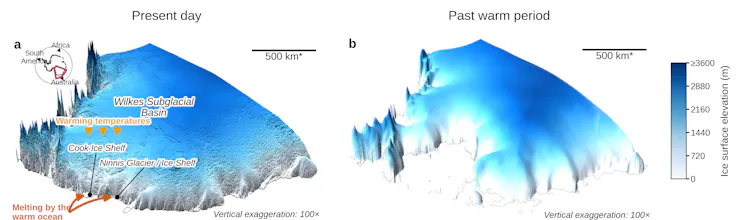
Au cours du Pliocène, il y a trois millions d’années, les températures atmosphériques mondiales étaient de 2 à 3 °C plus élevées qu’à l’époque préindustrielle moderne (La référence utilisée pour mesurer aujourd’hui l’augmentation des températures, NdT). La fonte des calottes glaciaires a entraîné leur recul de plusieurs centaines de kilomètres vers l’intérieur des terres, tandis que le niveau mondial des mers était de 6 à 23 mètres plus élevé. Les sédiments des fonds marins montrent que cela a radicalement modifié la forme de l’Antarctique.
Ces observations sont très préoccupantes, car la planète devrait atteindre un niveau de réchauffement similaire d’ici la fin du siècle.
Les projections indiquent que cela entraînera une accélération de la fonte et un recul spectaculaire de la calotte glaciaire du bassin de Wilkes. Ce que nous ignorons, c’est le délai dans lequel cela se produira.
Cette visualisation montre l’état actuel de la calotte glaciaire du bassin sous-glaciaire de Wilkes (à gauche) et une reconstitution de celle-ci pendant la période chaude du Pliocène (à droite).Fourni par l’auteur, CC BY-NC
Pourquoi est-il si difficile d’observer la glace ?
Le bassin sous-glaciaire de Wilkes figure parmi les endroits les moins observés de la Terre.
Ce n’est pas dû à son éloignement : il est relativement proche de l’Australie. Les habitants de Hobart, la capitale de l’état de Tasmanie, au sud de l’Australie, sont plus proches des principaux glaciers du bassin de Wilkes que d’autres régions antarctiques. Cela tient plutôt au fait que le bassin est protégé par un océan gelé – une banquise exceptionnellement épaisse, persistante et compactée.
Les images satellites peuvent fournir certaines données, mais les satellites ne voient pas à travers la glace et les océans. Les scientifiques devront s’y rendre en personne.
Cela ne sera pas facile. Accéder au bassin de Wilkes par la mer serait impossible sans les meilleurs brise-glaces. Aucun navire ne s’est jamais approché à moins de 150 kilomètres du glacier Cook, l’un des principaux glaciers du bassin de Wilkes.
Même si une expédition parvient à accéder à certaines zones, les scientifiques devront utiliser des capteurs robotisés pour cartographier de manière exhaustive les conditions océaniques et les fonds marins.
Sur terre, la station permanente la plus proche se trouve à 250 kilomètres.
La bonne nouvelle, c’est que le bassin de Wilkes devient accessible. L’Australie, la Nouvelle-Zélande et d’autres nations de l’Antarctique sont désormais mieux à même de parcourir de longues distances pour acheminer du carburant destiné aux relevés aériens et pour approvisionner les camps de terrain isolés.
De nouvelles technologies permettent de forer à plus de trois kilomètres de profondeur jusqu’au fond de la couche de glace du bassin et de prélever des échantillons des sédiments et du substrat rocheux sous-jacents.
Toute trace d’anciennes espèces océaniques présente dans les sédiments peut servir à déterminer jusqu’où et à quelle vitesse la glace s’est retirée pendant les périodes chaudes, lorsque l’océan pénétrait dans le bassin de Wilkes.
Une affaire inachevée
Les scientifiques pensaient autrefois que l’Antarctique mettrait des siècles à changer. Mais c’était trop optimiste. La glace terrestre fond plus rapidement, la banquise recule et les glaciers flottants, appelés « plates-formes glaciaires », fondent plus vite par le dessous.
Mener des travaux de terrain dans le bassin de Wilkes nécessitera un effort multinational de plusieurs années, en mer et sur terre.
Mais nous ne pouvons pas attendre encore un siècle pour comprendre la menace que représente cet énorme réservoir de glace.
Matt King a reçu des financements du Australian Research Council, du gouvernement australien (département du changement climatique, énergie, environnement et eau), du CSIRO, et d'ACCESS-NRI.
Nancy A.N. Bertler a reçu des financements du ministère du commerce, de l'innovation et de l'emploi; de l'université de Victoria à Welligton, de Earth Sciences New Zealand, et de la Royal Society of New Zealand.
Félix Hartmann, ingénieur de recherche en modélisation de la croissance des plantes, Inrae
Bruno Moulia, Directeur de Recherches , Biomécanique et mécanobiologie végétales, Inrae
Mélanie Decourteix, Maître de conférences en biologie végétale, Université Clermont Auvergne (UCA)
Les arbres perçoivent leur courbure et la rectifient activement grâce à un bois spécial dit « bois de tension », de manière analogue au contrôle postural des animaux.
Texte intégral (3284 mots)
Les arbres disposent d’outils pour percevoir leur environnement… et pour y réagir.Inrae – UCA, CC BY-SA
L’ESSENTIEL
Envers et contre toutes les bourrasques et les tempêtes, certains arbres poussent droit, imperturbables.
On sait, depuis les années 1950, que les troncs accueillent un type de bois particulier qui agit comme un muscle et peut courber la direction de pousse.
On réalise aujourd’hui que, aidés de plus par des outils qui leur permettent de sentir la gravité, la lumière et même leur propre courbure, ces « muscles » peuvent servir à se décourber.
Pour un arbre, pousser droit et vers le haut n’a rien d’évident. Une tempête ou un glissement de terrain peuvent l’incliner, voire le coucher à terre. Mais alors l’arbre se courbe progressivement pour que son sommet revienne vers la verticale. À l’inverse, si une trouée de lumière apparaît suite à la chute d’un voisin, l’arbre a tendance à se courber vers l’origine de la lumière.
Toutes ces courbures, dans un sens ou dans l’autre, pourraient rendre le tronc bien tortueux. Pourtant, on observe dans les futaies de grands arbres bien droits, malgré les tempêtes et les trouées de lumière.
Les arbres ont en fait une capacité d’adaptation posturale. En effet, une forme rectiligne et verticale leur assure l’accès le plus rapide à la lumière, ce qui est utile en forêt où la compétition peut être rude. Elle réduit aussi leur ploiement sous l’accroissement de leur poids et le risque de casse au vent.
Cette capacité est essentielle alors que les évènements extrêmes deviennent de plus en plus fréquents, et où les arbres subissent des coups de vent qui les renversent, des pertes de stabilité du sol ou même des glissements de terrain lors de fortes pluies…
Au cours de l’évolution, les plantes ont acquis la capacité à percevoir la direction de la gravité et celle d’où vient la lumière. Elles perçoivent aussi leur propre courbure – et nous venons de montrer comment les arbres parviennent à la corriger.
Les arbres poussent droit malgré les événements extérieurs qui influencent leur croissance. Ici, dans la forêt de hêtres des Colettes dans l’Allier, en France, connue comme l’une des plus belles hêtraies naturelles d’Europe.Bruno Moulia, Fourni par l'auteur
Comment les plantes perçoivent leur environnement… et leur propre forme
Par exemple, des photorécepteurs particuliers leur permettent de détecter une source lumineuse, c’est la « photoperception ».
Pour percevoir la direction de la gravité (« graviperception »), elles disposent tout le long de leurs tiges de cellules spécialisées qui indiquent où est le bas, grâce à de gros grains d’amidon, les « statolithes », qui s’accumulent au fond des cellules par gravité.
Ces grains rappellent les otolithes, les petits cailloux de notre oreille interne responsables de notre sens de l’équilibre. Mais alors que nos otolithes sont très sensibles aux accélérations, ce qui nous donne le tournis dans les manèges, les statolithes des plantes indiquent seulement l’inclinaison de la tige. Ils s’agitent en effet dans un milieu cellulaire très visqueux, ce qui amortit les accélérations.
En réponse à ses perceptions, un arbre peut courber activement son tronc. En effet, on sait depuis les années 1950 que le bois ne fait pas que soutenir le poids de l’arbre comme un squelette : il peut aussi servir de muscle.
Chez les espèces feuillues, ce « bois-muscle » s’appelle le bois de tension. Il se forme sur la face supérieure des tiges inclinées. Chaque nouvelle fibre de bois formée, en se contractant, contribue à courber progressivement le tronc sur des semaines ou des années (plus le tronc est épais, plus ce processus requiert de fibres). Ce bois est redouté des scieurs, car la tension accumulée du fait de gros secteurs de bois de tension peut provoquer des éclatements à l’abattage, ou des déformations après découpe.
Mais le bois de tension peut-il jouer le rôle inverse, c’est-à-dire décourber le tronc en réponse à sa proprioception ? Notre hypothèse était que du bois de tension se formerait sur la face opposée à la courbure : on aurait alors un couple de zones de bois de tension de chaque côté du tronc, qui agiraient successivement comme des muscles antagonistes, tels nos muscles dorsaux et abdominaux qui nous permettent de nous « tenir droit ».
Mais pour observer clairement la proprioception à l’œuvre, il faut annuler les autres perceptions, en particulier la photoperception et la graviperception. C’est ce que nous avons fait, grâce à un dispositif expérimental original.
Bain de lumière et manège à plantes
Nous avons placé de jeunes peupliers dans des sphères d’1,5 mètre de diamètre, à l’intérieur desquelles la lumière arrive de toutes les directions à la fois. Dans ce dispositif, la lumière est toujours utilisée par les peupliers pour leur photosynthèse, mais elle n’a aucune influence sur leur direction de croissance.
Pour étudier la croissance des peupliers, ce dispositif permet d’envoyer la lumière dans toutes les directions à la fois et de faire tourner la plante pour annuler sa perception de la gravité.Inrae -- UCA, CC BY-SA
Pour annuler la perception de la direction de la gravité, nous avons combiné la sphère avec un système déjà existant, appelé « clinostat ». Il s’agit d’un socle tournant autour d’un axe horizontal à la vitesse d’un à deux tours par minute. Lorsqu’une plante est placée dans un clinostat, ses organes sont orientés alternativement vers le haut et le bas. Les statolithes se retrouvent mis en suspension dans les cellules, répartis aléatoirement, ce qui prive la plante de la perception du haut et du bas.
Courbure et décourbure d’un peuplier
Au début de l’expérience, chaque peuplier est placé à l’horizontale dans une sphère. Le clinostat n’est pas encore activé. Le peuplier perçoit donc son inclinaison par rapport à la gravité (sans influence de la lumière) et se courbe vers le haut, comme attendu. Une dizaine de jours suffisent pour qu’une courbure bien nette apparaisse. C’est alors que le clinostat est enclenché, ce qui suspend la perception de la gravité. Il ne reste plus à l’arbre pour s’orienter qu’une seule perception, celle de sa propre courbure, la proprioception. Au cours des semaines qui suivent, le tronc du peuplier se décourbe progressivement jusqu’à devenir rectiligne.
Images en time lapse : trois positions successives du peuplier durant son mouvement de courbure vers le haut. Il repasse par ces positions (alors qu’il tourne sur lui-même) en se rectifiant.Inrae -- UCA, CC BY-SA
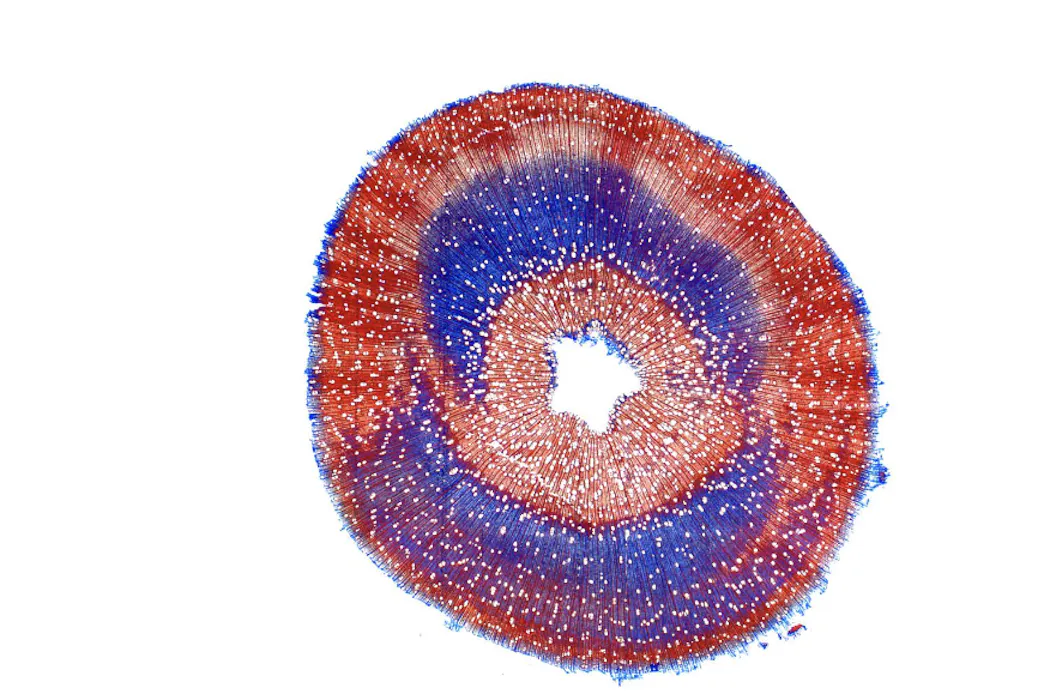
À la fin de l’expérience, nous avons fait des coupes transversales des troncs de peupliers. Une coloration spécifique permet de mettre en évidence le bois de tension. Et comme le bois se forme en couches successives, on peut estimer la période de production des cellules de bois à partir de leur position par rapport au centre du tronc.
Coupe transversale d’un tronc de peuplier en fin d’expérience. Le bois de tension est coloré en bleu. Il s’est formé sur la face supérieure avant l’activation du clinostat et sur la face inférieure après l’activation du clinostat.Inrae -- UCA, CC BY-SA
Sur ces coupes, nous avons observé que du bois de tension s’était formé sur la face supérieure durant la première phase de l’expérience, quand le clinostat n’était pas activé. Grâce à lui, le tronc a pu se courber vers le haut. Puis dès l’enclenchement du clinostat, cette formation de bois de tension a cessé et un nouveau bois de tension a commencé à se former sur la face opposée, comme nous en avions fait l’hypothèse.
C’était la preuve que le mouvement de décourbure du tronc a été engendré par du bois de tension, en réponse à la proprioception, et jouant un rôle équivalent à celui d’un muscle antagoniste chez un animal.
Ainsi, nous avons mis en évidence une boucle sensorimotrice de contrôle postural, une capacité que l’on pensait réservée aux seuls animaux.
S’adapter à l’environnement, sans nerfs ni cerveau
Dans l’environnement naturel de l’arbre, toutes les perceptions se combinent dans des proportions variables. L’arbre est capable d’intégrer ces différents signaux pour y réagir adéquatement en produisant du bois de tension quand il le faut, là où il le faut.
Dans des arbres non clinostatés, nous avons toujours retrouvé des secteurs de bois de tension opposés permettant de rectifier le tronc, qui avaient probablement été négligés comme des anomalies non significatives dans les études antérieures.
C’est ainsi qu’un arbre adapte constamment sa posture à son environnement, sans système nerveux central.
Des arbres en forme pour des forêts et une exploitation plus robustes
Nous l’avons vu, une forme rectiligne est essentielle pour les arbres car c’est ce qui leur permet d’accéder à la lumière et de moins ployer sous leur propre poids au risque de casser.
Mais ces capacités sensorielles et d’adaptation sont aussi utiles pour nous, les humains, afin de disposer de fûts droits et avec un bois homogène pour son usage en construction et ameublement. Si, pendant longtemps, les recherches sur la qualité des bois ont essayé de sélectionner des arbres qui ne produisaient quasiment pas de bois de tension, nos recherches montrent désormais que c’était une erreur. Pour obtenir des fûts rectilignes sans gros secteurs de bois de tension, ce qu’il faut, ce sont des arbres alliant sensibilité proprioceptive et puissance de leur bois de tension pour que les corrections de posture soient efficaces et rapides.
Le projet a bénéficié du soutien de l’Agence nationale de la recherche (ANR), qui finance en France la recherche sur projets (Perception de la gravité chez les plantes : de la cellule à la réponse biomécanique. — GRAP2 ANR-13-BSV5-0005. L’ANR a pour mission de soutenir et de promouvoir le développement de recherches fondamentales et finalisées dans toutes les disciplines, et de renforcer le dialogue entre science et société. Pour en savoir plus, consultez le site de l’ANR.
Félix Hartmann a reçu des financements de l'ANR.
Pour les travaux discutés ici Bruno MOULIA a reçu des financements de :
French Space Agency (CNES).
IDEX-ISITE initiative 16-IDEX- 0001 and the International Research Center on Sustainable AgroEcosystems (ISITE CAP20-25).
Plus largement ses recherches ont été financées par l'ANR et par l'Europe , ainsi que, de manière ponctuelle, par le Fonds de Soutien à l'Obtention Végétale et par l'Institut Français du Caoutchouc
Mélanie Decourteix a reçu des financements dans le cadre des appels à projets du CNES, de l'IRC-SVSAE (I-SITE) de Clermont-Ferrand, de Clermont Auvergne Metropole, du département AES d'INRAe et de l'ANR.
Véronique Sadtler, Professeure, Université de Lorraine
Le shampoing solide promet une cosmétique plus sobre, mais passer du liquide au solide impose de revoir toute la formulation du produit. Nos habitudes compliquent aussi son adoption.
Texte intégral (3049 mots)
Entre défis de formulation et habitudes tenaces, le shampoing solide peine à s’imposer durablement.Freestocks/Unsplash, CC BY
L’ESSENTIEL
Depuis les années 1930, le shampoing liquide a façonné nos attentes de mousse, de démêlage et de douceur.
Formuler un shampoing solide performant est un vrai défi technique.
Pour adopter durablement le solide, il faudra peut-être aussi revoir ce que nous attendons d’un shampoing.
Se laver les cheveux semble aujourd’hui d’une grande simplicité. Pourtant, nous attendons beaucoup du shampoing que nous utilisons : qu’il élimine l’excès de sébum et les salissures, mais aussi qu’il mousse suffisamment, se répartisse et se rince rapidement, tout en laissant les cheveux brillants, faciles à démêler et agréables au toucher.
À cette liste déjà longue s’ajoutent désormais souvent d’autres exigences : réduire les emballages, particulièrement les plastiques, transporter moins d’eau et, plus largement, diminuer l’impact environnemental du produit.
Le shampoing solide semble apporter une réponse à plusieurs d’entre elles. Pourtant, après un engouement rapide, sa progression marque le pas. Pourquoi ?
Du savon au shampoing moderne
Avant le développement des détergents synthétiques au XXᵉ siècle, le savon est employé pour de nombreux usages de lavage, aussi bien domestiques que pour l’hygiène corporelle. Il sert notamment à nettoyer les cheveux.
Cependant, le savon présente des limites lorsqu’il est utilisé sur les cheveux. Son caractère alcalin favorise le gonflement de la fibre et modifie l’état de sa surface. En présence d’une eau riche en calcium ou en magnésium, il peut également former des dépôts insolubles, difficiles à éliminer des cheveux et du cuir chevelu. Les cheveux peuvent alors paraître ternes, rêches et difficiles à coiffer.
Ces inconvénients conduisent au développement de produits spécifiquement conçus pour le lavage des cheveux.
Publicité pour l’un des premiers shampoings liquides commercialisé en Europe, au début des années 1930, en Allemagne.Wikimédia, CC BY
Le savon cède peu à peu la place à d’autres tensioactifs, dits synthétiques, qui offrent notamment la possibilité de travailler à des pH mieux adaptés aux cheveux et au cuir chevelu. Les tensioactifs sont les molécules qui permettent d’assurer le liant entre l’eau et les graisses et donc de laver. Les produits lavants utilisant ces molécules à la place du savon sont désignés sous le terme de syndets, contraction de synthetic detergents. À partir de 1930, les premiers shampoings sans savon sont commercialisés en Europe et aux États-Unis.
Au fil des décennies, la composition des shampoings se sophistique : différents tensioactifs sont associés pour ajuster le nettoyage et la mousse, des agents conditionnants facilitent le démêlage et améliorent le toucher, tandis que d’autres ingrédients agissent sur la viscosité, la stabilité ou les propriétés sensorielles du produit.
Au fil de ces innovations, le shampoing ne se contente plus de laver : il devient aussi un produit de soin et de plaisir d’utilisation.
Quand les progrès techniques deviennent des habitudes
Parallèlement, les pratiques évoluent. En France, au milieu du XXᵉ siècle, de grandes campagnes publicitaires font la promotion de l’hygiène capillaire jusque dans les écoles. Elles mettent en scène la brillance, la mousse et le plaisir du lavage.
Parmi les nombreux jeux radiophoniques, figure un « Concours de mousse », signe de la place que celle-ci prend peu à peu dans la représentation du shampoing. La mousse participe à la répartition du produit mais son abondance ne mesure pas directement l’efficacité du nettoyage. Elle joue surtout un rôle important dans la perception de la performance et l’expérience d’utilisation du shampoing. Des travaux très récents montrent que cette expérience possède même une dimension émotionnelle, jusqu’au son produit par la mousse, qui peut modifier la manière dont elle est perçue.
D’autres propriétés participent également à l’expérience d’utilisation, comme la facilité de rinçage, le démêlage ou le toucher des cheveux après séchage.
À force d’innovations, ces performances autrefois nouvelles sont devenues des critères de qualité que nous considérons désormais comme allant de soi.
Puis le shampoing devint solide
C’est dans ce contexte que s’inscrit l’essor du shampoing solide, au sein d’un mouvement plus large touchant l’ensemble de la cosmétique : déodorants, nettoyants pour le visage, dentifrices ou après-shampoings se déclinent désormais sous des formes solides.
Les raisons de cet engouement sont faciles à comprendre. La quantité de produit nécessaire par usage peut être sensiblement plus faible et sa forme concentrée permet également de réduire fortement l’emballage, notamment plastique, voire de s’en passer selon les conditionnements. Cela permet aussi de réduire certains impacts environnementaux liés au transport et au conditionnement.
La faible teneur en eau modifie aussi les contraintes microbiologiques. Une enquête récente portant sur 172 shampoings solides commercialisés dans quatre pays européens montre que la présence et la concentration des conservateurs y sont moins importantes que dans les shampoings liquides.
À ces caractéristiques s’ajoute une image de simplicité et de naturalité fréquemment associée, à tort ou à raison, au format solide. Cependant, à elles seules, ces caractéristiques ne suffisent pas à garantir un meilleur bilan environnemental sur l’ensemble du cycle de vie. Par exemple, pour un shampoing, la phase d’utilisation, et notamment l’eau chaude consommée sous la douche, peut représenter une part importante des impacts.
Le mouvement a néanmoins été rapide. En France, la proportion de consommateurs ayant acheté au moins un cosmétique solide est passée de 1 % en 2019 à 7,5 % en 2021 ; le marché atteignait 85,5 millions d’euros entre novembre 2021 et octobre 2022.
Le shampoing solide est devenu l’une des vitrines les plus visibles de cette nouvelle cosmétique.
Solide ne veut pas dire savon
Le retour à une forme solide n’est pas pour autant un retour au savon. Pour conserver les performances acquises par les shampoings modernes sans retrouver notamment les inconvénients liés au caractère alcalin du savon, de nombreux shampoings solides reposent sur des tensioactifs autres que le savon : ce sont des syndets solides.
« Synthétique » ne signifie d’ailleurs pas nécessairement « issu du pétrole ». Des tensioactifs sont obtenus par synthèse chimique tout en incorporant des matières premières d’origine renouvelable, par exemple issues de corps gras, de sucres ou d’acides aminés. La molécule finale reste le résultat d’une transformation chimique.
Le format change donc profondément, mais pas nécessairement les principes chimiques du lavage. L’enjeu consiste plutôt à conserver les acquis du shampoing moderne dans une architecture très différente. Et c’est là que les difficultés commencent.
La mousse, longtemps associée à l’efficacité et au plaisir du lavage, est devenue l’un des critères par lesquels nous jugeons un shampoing.Matthew Tkoc/Unsplash, CC BY
Tous les ingrédients employés dans un shampoing liquide ne peuvent pas être transposés tels quels dans un pain solide. Certains tensioactifs sont disponibles sous forme liquide ou contiennent eux-mêmes une quantité non négligeable d’eau, ce qui restreint leur incorporation dans une formulation très peu aqueuse.
L’eau, de son côté, n’est pas un simple constituant que l’on pourrait retirer sans conséquence : elle sert de milieu de dispersion ou de solubilisation, contribue à la texture et facilite la répartition rapide du produit sur la chevelure.
Un shampoing solide ne résulte donc pas simplement du retrait de l’eau d’une formule liquide : il faut conserver les fonctions attendues du shampoing tout en construisant un produit aux propriétés physiques adaptées à sa fabrication et à son utilisation.
Passer au solide impose par conséquent de reformuler entièrement, pas seulement de concentrer une recette existante.
Les difficultés rencontrées dans les formulations solides concernent la dureté et la plasticité du pain, sa fissuration, son ramollissement, sa perte de masse à l’usage ou encore la qualité de la mousse obtenue.
Le pain doit être assez cohésif pour être fabriqué, transporté et manipulé, assez résistant pour ne pas se déliter rapidement dans l’atmosphère humide d’une salle de bains, mais suffisamment accessible à l’eau pour délivrer efficacement ses constituants pendant l’utilisation.
À ces contraintes propres au format solide, s’ajoute la nécessité de retrouver la douceur et le démêlage auxquels les shampoings liquides nous ont habitués. Le remplacement d’ingrédients conventionnels par des alternatives d’origine naturelle ou biosourcée pose aussi des défis de performance, de stabilité et de compatibilité avec les formulations.
Or, améliorer une propriété peut en dégrader une autre. C’est le quotidien de la formulation : rechercher le meilleur compromis entre performances, propriétés sensorielles et nouvelles exigences de durabilité plutôt qu’une formule parfaite qui n’existe pas.
L’écologie suffit-elle à changer nos habitudes ?
À cette difficulté technique s’en ajoute une autre : celle de nos comportements.
Après l’essor spectaculaire du début des années 2020, le marché français des cosmétiques solides a reculé de 3,2 % en volume en 2022 et 2023. Ce chiffre ne permet évidemment pas d’attribuer cette inflexion au shampoing, encore moins à sa seule sensorialité : prix, distribution, contexte économique ou évolution de l’offre peuvent également intervenir. Il montre en revanche qu’un engouement initial ne conduit pas nécessairement à l’installation durable d’une nouvelle pratique.
De surcroît, connaître les bénéfices d’une solution ou adhérer à un objectif ne suffit pas toujours à modifier les pratiques. Les comportements dépendent aussi des habitudes, des normes sociales, des contraintes matérielles et du contexte dans lequel ils s’inscrivent.
Le shampoing solide fournit un cas très concret de cette difficulté. Une étude consacrée spécifiquement aux raisons de sa non-adoption montre l’importance des habitudes et de l’image du produit. Les réponses font également ressortir des freins fonctionnels : conservation du pain sous la douche, sensation laissée sur les cheveux ou différences de performances entre produits.
Les consommateurs peuvent donc souhaiter réduire leurs emballages et la quantité d’eau transportée, tout en continuant à rechercher les qualités sensorielles acquises avec les produits qu’ils utilisent depuis longtemps.
Et si l’innovation consistait à faire évoluer nos attentes ?
Reste alors à savoir si l’écoconception doit reproduire à l’identique tout ce que plusieurs décennies d’innovation nous ont appris à attendre d’un shampoing. Une mousse un peu différente, un nouveau geste à acquérir ou une texture inhabituelle constituent-ils forcément des régressions ?
Pendant des décennies, l’innovation a façonné les produits, mais aussi les usages et les critères par lesquels nous les jugeons. La transition vers des produits plus sobres pourrait donc appeler un mouvement réciproque : continuer à améliorer leur conception, mais accepter aussi que certaines pratiques et certaines manières d’apprécier leurs performances puissent changer.
Le défi ne serait alors plus seulement de proposer le shampoing en bouteille ou sous forme solide, mais de faire évoluer ensemble les produits, leurs usages et ce que nous en attendons.
Véronique Sadtler ne travaille pas, ne conseille pas, ne possède pas de parts, ne reçoit pas de fonds d'une organisation qui pourrait tirer profit de cet article, et n'a déclaré aucune autre affiliation que son organisme de recherche.