
Articles intégraux en PDF
The Deep Green Resistance News Service is an educational wing of the DGR movement. We cover a wide range of contemporary issues from a biocentric perspective, with a focus on ecology, feminism, indigenous issues, strategy, and civilization. We publish news, opinion, interviews, analysis, art, poetry, first-hand stories, and multimedia.
▸ les 2719 dernières parutions
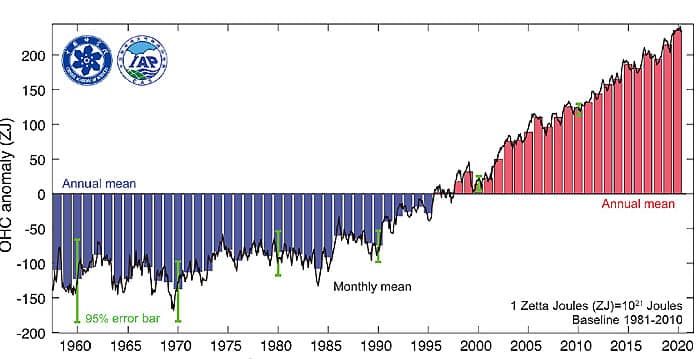
Despite Covid Slowdown - Upper Ocean Temperatures Set a New High Record in 2020
Originally published on Climate and Capitalism Over 90% of the excess heat due to global warming is absorbed by the oceans. Heat content change in the upper 2000 meters of the global ocean. (Advances in Atmospheric Sciences, January 2021) Even with the Covid-19-related small dip in global carbon emissions due to limited travel and other activities, the ocean temperatures continued a trend of breaking records in 2020. A new study by 20 scientists from 13 institutes around the world, reported the highest ocean temperatures since 1955 from surface level to a depth of 2,000 meters.The study was published in Advances in Atmospheric Sciences on January 13. It concluded with a plea to the policymakers and others to consider the lasting damage warmer oceans that can be caused as they attempt to mitigate the effects of climate change. (182 mots)
Green Flame: Nuclear Waste: A Million Years of Cancer
This episode of the Green Flame podcast is a discussion based on the film " Ocean Poubelles." We talk about nuclear waste, the nuclear waste industry, nuclear waste dumping, and the production of nuclear weapons, nuclear power, and nuclear medicine that results in this highly dangerous and long-lasting radioactive material. Nuclear waste is a massive issue. It’s actually a much more serious danger in the nuclear industry than a meltdown or some Chernobyl type incident. Nuclear waste is something that is ubiquitous in the nuclear industry and nobody really knows what to do with it. There’s no safe way to store it. There’s nothing that can be done to safely “dispose” of materials that will be deadly for tens of thousands, hundreds of thousands, millions of years into the future. Our discussion this week is on this topic of nuclear waste, which in many ways is a fascinating insight into industrial civilization, how it functions, the mindset of the technocrats that run the largest corporations in the world, the militaries and so on. (188 mots)
The Most Important Climate News of The Past Decade
For many years, Deep Green Resistance has argued that it’s not “too late” to stop global warming, because scientific predictions for the future never assume that emissions may fall to zero. Now, science has backed up our assertion. The following is excerpted from a longer article by Bob Berwyn, published on Inside Climate News, and re-posted here with permission from the author. This is, in our estimation, the most important climate change story of the decade. (91 mots)
PRESS RELEASE: Water Protector Climbs Into Line 3 Pipeline Trench To Stop Work
This news release outlines direct action taken by water protectors. On Monday morning, Nia Zekan, a water protector, climbed into a pipe trench along the Line 3 Pipeline easement, shutting down work for approximately four hours. Nia halted construction at this Enbridge worksite while dozens more stood around in support of Nia and resistance to Line 3. The site is located on the Fond Du Lac reservation in so-called northern Minnesota, right next to Camp Migizi, a recently-opened space for water protectors. (89 mots)
Activists Occupy Site of Proposed Mine That Would Provide 25% of World’s Lithium Supply
Lithium is the miracle element powering your smartphone and under the hood of every electric car. Will batteries save the planet or cause more harm? The controversy is heating up in Nevada. Activists aiming to stop an open-pit lithium mine launched a permanent protest encampment last Friday. They invite supporters to join them. Despite winter conditions at Thacker Pass, the site of the proposed $1.3 billion Lithium Americas mine, protestors have erected tents, a wood stove, and protest signs. Lawyer Will Falk, who is on site, says they mean to stay for as long as it takes to protect this old-growth sagebrush mountainside. (124 mots)
RENO, Nevada
Suspension Of Farm Laws In India
This news article describes the impact of corrupt legislation on ordinary working people. The organised protests and solidarity of the public with farmers is an excellent example of how coordinated resistance can enable change. Editor’s note: DGR strongly opposes the three new farm laws that have inspired the farmer’s protests in India. However, we do not necessarily agree with all of the demands of the protestors. On 12th January, 2021, the Supreme Court of India suspended the ‘Three Contentious Farm Laws, amidst large scale protests from farmers in India. The three farm laws continue to be hailed by the ruling party as a means on giving farmers more autonomy over selling of their crops and will break big monopolie s. Yet, it is the farmers who have mobilized and organized the mass-scale protests against the laws. (178 mots)
Land Defenders Murdered In Columbia
DGR stand in solidarity with land defenders in the Philippines`` and Colombia, where we see the highest levels of murders of environmental activists. “For years, land and environmental defenders have been the first line of defence against climate breakdown. Yet despite clearer evidence than ever of the crucial role they play, far too many businesses, financiers and governments fail to safeguard their vital and peaceful work.” Globalwitness.org There are also a huge diversity of cultures. In 2019, Colombia was the worst country to be an environmental activist. There was hope this would improve in 2020 but sadly this was not the case. Worse still, Colombia started on new year’s day in 2021 with the murder of young people who were who fought with the guerrilla organization The Revolutionary Armed Forces of Colombia (FARC) and had demobilized to return with their family after the peace agreement was signed in June 2016. FARC signed a ceasefire accord with the President of Colombia. A year later, FARC handed over its weapons to the United Nations. At this point it ceased to be an active, armed group. (244 mots)
Colombia, is a country with amazingly diverse ecosystems.
Green Flame: Chaos in Washington D.C.
This episode, recorded January 7th 2021 is a round table discussion of the January 6th protest and riots in Washington D.C. in the U.S. Capitol. The hosts for this episode are Max Wilbert and Jennifer Murnan. They are joined by Saba Malik and Will Falk. The discussion starts with Will outlining his work and allegiance to the natural world, and includes the needs for anti-civilization and a strong biophilic analysis. Saba is clear that the dominant US culture was founded upon kidnapping and genocide. Max describes the destruction of the systems of life support on Earth (soils, waters) and the current unrest is a sign of the collapse of empire. Jennifer describes the insanity of the recent events and asserts that people are literally going mad. Saba relates the earth as an organism in crisis because she is being killed and the behaviour of some people demonstrates the crisis and insanity. (191 mots)
Whale Populations Still at a Fraction of Historic Levels
Derrick Jensen interviews activists each week. This week Derrick interviews Cayte Bosler. Cayte is an investigative environmental journalist and a graduate student at Columbia University. She researches solutions for protecting biodiversity and has worked with land-based communities and wildlife defenders throughout Latin America. Her interest is in chronicling community-led resistance to exploitation and ecological abuse to inspire resistance elsewhere. Today we talk about whales. [Whales] are some of the most elusive creatures on the planet. They spend 99% of their lives under water, far beyond any of our observational tools. Even with the sliver of what we do know, it’s so fascinating. (125 mots)
Ready To Resist
In this short essay Salonika relates what resistance personally means to her. By Salonika The system is fucked-up. If you are reading this, you probably know this already. You’re here because you know how fucked-up the system is. You know that it is based on the oppression of humans, nonhumans and the entire planet. You know that we need to fight this system, that we need to resist it with all we have. You may already be doing that anyway. I’m going to share some of the ways that I have resisted. (121 mots)
Bon Pote
Actu-Environnement
Amis de la Terre
Aspas
Biodiversité-sous-nos-pieds
Bloom
Canopée
Décroissance (la)
Deep Green Resistance
Déroute des routes
Faîte et Racines
Fracas
F.N.E (AURA)
Greenpeace Fr
JNE
La Relève et la Peste
La Terre
Le Lierre
Le Sauvage
Low-Tech Mag.
Motus & Langue pendue
Mountain Wilderness
Negawatt
Observatoire de l'Anthropocène