17.08.2026 à 02:00
L’onanisme des utilisateurs de chatbots
Ploum
Texte intégral (2336 mots)
L’onanisme des utilisateurs de chatbots
Quand bien même les chatbots ne seraient pas les produits de gigantesques entreprises centralisées qui cherchent à nous exploiter en pourrissant nos cerveaux et Internet tout en étant une catastrophe écologique et sociale, je ne les utiliserais pas.
Quand bien même l’outil serait éthique à tous les points de vue, je le détesterais !
Le guitariste et le joueur de Guitar Hero
John Scalzi explique enfin pourquoi je n’aime pas ça. Parce que ç’est littéralement une perte de temps, un jeu vidéo qui ne sert à rien.
Il prend l’analogie de Guitar Hero : oui, c’est fun. Mais, fondamentalement, c’est inutile. Vous n’apprenez rien ! En demandant à un chatbot de répondre à une question, de produire un texte ou une image, vous n’avez littéralement rien appris. Les études le montrent : un étudiant qui répond à une question d’un prof en utilisant ChatGPT est incapable de répéter cette réponse quelques minutes plus tard. L’investissement intellectuel est nul. L’étudiant est comme une interface transparente entre le chatbot et le prof.
Je l’ai vécu lors d’un examen où j’avais autorisé l’usage de l’IA : un étudiant a été incapable de répondre à une question alors que la réponse était affichée sur son écran.
Mais, comme Guitar Hero, jouer avec un chatbot est amusant, voire addictif.
Je le comprends très bien. J’ai pris une demi-heure pour jouer avec la génération d’images de Lumo, le chatbot de Proton. Je lui ai demandé une couverture de Bikepunk et j’ai itéré en notant les défauts. J’avais plein de choses à dire sur l’output (notamment que, quoi qu’on fasse, une jeune femme à vélo doit obligatoirement porter un crop top). C’était très marrant de voir que quand j’ai précisé que je voulais que le personnage masculin ressemble à Thierry Crouzet, il a soudainement acquis une musculature impressionnante. Ce n’est pas que Thierry n’est pas musclé en vrai, mais, quand même, j’évite d’éternuer trop fort dans sa direction.
Et là, vous voyez le truc : c’était amusant. Ça me donnait envie de partager les différentes images.
Mais, en réalité, quand on n’est pas dans le délire, c’est juste nul. C’est comme regarder un pote jouer à Guitar Hero : il s’éclate, mais c’est un peu emmerdant pour le public. Voir c’est gênant. Un peu comme si vos amis vous racontaient à quel point leurs dernières séances masturbatoires étaient jouissives.
L’utilisation de l’IA est un plaisir solitaire. Je n’ai rien contre le fait que ça vous amuse, mais, par pitié, ne le partagez pas avec moi !
On ne gagne pas du temps en poussant sur un bouton
Les gens disent gagner du temps avec l’IA, mais ils n’améliorent pourtant pas leur productivité. Le paradoxe viendrait que le temps pris à utiliser l’IA lui-même ne serait, intuitivement, pas pris en compte.
C’est un paradoxe bien connu des bons managers : le management prend du temps et de l’énergie. Souvent plus que faire les tâches soi-même. Si tu engages un jardinier pour tondre ta pelouse, tu dois trouver le jardinier, le contacter, convenir d’un rendez-vous, négocier un tarif puis, une fois qu’il est là, lui expliquer le travail, vérifier qu’il a bien compris et puis vérifier qu’il a fait tout correctement.
Outre l’argent que ça coûte, cela n’est clairement pas une tâche anodine. En fait, si c’est juste pour faire une seule fois un petit jardin, c’est beaucoup plus rentable de tondre ta pelouse toi-même. Le bénéfice ne se fait sentir que lorsque tu as confiance et que tu as un accord pour que le jardinier vienne une fois par mois tondre une grande pelouse, sans même avoir besoin de te prévenir.
Les jeunes parents connaissent tous cela : junior veut absolument aider au montage du meuble Ikea, mais, honnêtement, ça te prend cinq fois plus de temps que de le faire tout seul.
On en est là avec l’IA. Parfois on gagne un peu de temps (une vraiment grande pelouse à tondre), parfois on en perd (l’armoire Ikea), mais l’attrait de la nouveauté fait que c’est fun. Un peu comme le fait de regarder un jardinier travailler depuis son salon en lui donnant des ordres. Cela donne un sentiment de puissance. C’est littéralement masturbatoire.
Le problème c’est que la rentabilité à long terme de notre jardinier se base sur le fait de créer une confiance, un automatisme. Et là, on est face à une entreprise de jardinage qui a un monopole mondial, qui augmente ses tarifs arbitrairement et envoie, à chaque fois, un nouvel ouvrier qui ne connait pas votre jardin, mais fait semblant du contraire. En plus, il est sous ecstasy.
Vos outputs de chatbots sont de la pollution
Mon principal grief, c’est que les utilisateurs des chatbots sont persuadés d’avoir une compétence ou une valeur ajoutée quelconque. J’en ai été témoin de première main : les projets open source sont noyés de contributions générées. Souvent, les utilisateurs sont de bonne foi : ils ont réellement trouvé un bug et plutôt que de le rapporter, ils demandent à un LLM de générer un patch.
Parfois, ils poussent le vice jusqu’à faire écrire le rapport de bug par le LLM. Ils sont très fiers.
Fier de quoi ? D’avoir cliqué sur l’icône Claude ou ChatGPT ?
Et c’est une catastrophe : parce que le mainteneur doit désormais tenter de comprendre dans tout ce charabia et ce jargon quel est le problème de base. Au lieu d’avoir un utilisateur qui se plaint, parfois un peu maladroitement, nous sommes face à une machine qui réinterprète tout et il faut deviner ce que l’utilisateur avait en tête. En gros, il faut essayer de déduire le prompt.
Ce n’est déjà pas évident de se comprendre entre humains en communication directe alors si un chatbot sert d’intermédiaire…
Ou cette connaissance à qui je pose une question et qui m’envoie la réponse de ChatGPT. Comme si c’était d’une aide quelconque. Parce que si je demande quelque chose à quelqu’un, c’est vraisemblablement parce que je ne trouve pas de réponse facile et que je pense que cette personne a une expertise du domaine. Me renvoyer la réponse de ChatGPT est à la fois injurieux (tu n’en as rien à foutre de m’aider) et hautain (tu penses que je ne suis pas capable de faire une recherche Web).
Que ce soit clair : un output de chatbot n’est pas fait pour être partagé. Si vous souhaitez le faire, alors partagez juste le prompt, ce sera beaucoup plus efficace.
De plus en plus d’artistes professionnels se plaignent : plutôt que d’avoir des instructions claires, les clients leur envoient des « idées » générées par IA. Et les artistes doivent deviner ce que veulent leurs clients.
Le chatbot, c’est comme la masturbation : pratiquez-le seul ou dans un cercle restreint d’adultes consentants. Jamais en public. Jamais en présence de personnes non consentantes. Jamais dans un cadre professionnel.
Apprendre de ses expériences
Mais le principal problème, outre l’opacité de la communication, c’est ce que dit Scalzi avec Guitar Hero ou comme le montre l’analogie de la masturbation : vous n’apprenez rien.
Vous ne saurez pas jouer bon anniversaire à la guitare même après des centaines d’heures de Guitar Hero. Vous ne rencontrerez jamais un partenaire amoureux en vous masturbant. Ce n’est pas un jugement de valeur : c’est juste que ces activités n’ont pas le moindre rapport entre elles !
L’énorme majeure partie des patches que je reçois pour mes projets Open Source me prennent plus de temps à relire et à intégrer que si je le faisais moi-même. Pourtant, j’apprécie cela, car je sais que la personne a dû fournir un effort pour comprendre mon code. Elle a appris. Et, petit à petit, elle va être de plus en plus à l’aise pour faire des changements plus importants tandis que moi, j’aurais appris à lui faire confiance. Je peux également poser des questions sur les choix techniques qui ont été faits, en discuter, remettre en question mes propres perspectives, mes propres choix.
Accepter un patch n’est jamais un gain de temps, c’est un investissement sur le futur. C’est également une manière de faire grandir deux personnes.
Ce qui n’est pas le cas avec les patchs générés. C’est même exactement le contraire : accepter un patch généré va introduire dans le projet du code qui fonctionne peut‑être aujourd’hui, mais que personne ne comprend et, surtout, dont on ne peut même pas présupposer qu’il a une logique.
Si vous n’avez rien appris en utilisant un chatbot et si la personne qui reçoit l’output n’apprend rien, pourquoi le faire tout court ?
Un tas de débris aléatoire n’est pas une maison
Vous vous souvenez de l’expérience de pensée qui dit que si on assied assez de chimpanzés qui tapent aléatoirement sur des machines à écrire, on va finir par générer du Shakespeare ou du Proust ?
Et bien c’est exactement ce que font les chatbots avec le code : ils génèrent presque aléatoirement des morceaux de code jusqu’à ce que le code en question réponde superficiellement à la question. Ça fonctionne, parfois, ici et maintenant, mais, bien entendu, ça va craquer de partout dès qu’on bouge quelque chose.
Un peu comme si on construisait une maison en jetant aléatoirement des poutres et des briques jusqu’à ce que, ô miracle de la loi des grands nombres, l’édifice de matériau dégage un espace assez grand pour qu’on l’appelle "chambre" avec une ouverture appelée "porte". Ce serait cool.On prendrait des photos.
Mais pensez-vous sérieusement que cette "maison" tiendrait face à la première pluie, au premier souffle de vent ou à la première vibration d’un camion sur la route ?
De la même façon, communiquer par écrit est une compétence qui se travaille. C’est même plus important que cela : l’écrit permet de structurer ses propres pensées. Tant que vous n’avez pas écrit vos idées, elles ne sont pas réelles, pas claires.
Tant que vous n’avez pas fixé votre idée sur un support, elle ne vaut rien. Et si ce n’est pas vous qui la fixez, ce n’est pas votre idée.
En déléguant l’écriture de vos emails et de vos rapports, non seulement vous perdez la compétence communicationnelle, mais, pire, vous perdez simplement vos idées.
Les singes bientôt remplacés ?
Dans le cliquetis des milliards de machines à écrire actionnées par les singes, une feuille tomba soudainement sur le sol. Un entrepreneur s’en saisit et lut : « Longtemps, je me suis couché de bonne heure… »
— Ça y est, hurla-t-il ! Nous avons réussi ! Ce singe écrit du Proust !
Le singe en question fut mis sur un piédestal, choyé, dorloté. Mais les entrepreneurs avaient beau faire, il n’écrivait plus que du charabia sans signification.
— Dommage, fit un entrepreneur. Peut-être n’est-ce pas la bonne approche.
— Et si nous remplacions les singes par des utilisateurs de ChatGPT ?
— Pas bête. Statistiquement, ça devrait fonctionner…
— Et puis, on ferait des économies de bananes !
À propos de l’auteur :
Je suis Ploum et je viens de publier Bikepunk, une fable écolo-cycliste entièrement tapée sur une machine à écrire mécanique. Pour me soutenir, achetez mes livres (si possible chez votre libraire) !
Recevez directement par mail mes écrits en français et en anglais. Votre adresse ne sera jamais partagée. Vous pouvez également utiliser mon flux RSS francophone ou le flux RSS complet.
10.08.2026 à 02:00
L’arnaque du bilan carbone
Ploum
Texte intégral (2505 mots)
L’arnaque du bilan carbone
Pourquoi nous nous sommes fait avoir dans notre soi-disant lutte contre le réchauffement climatique
Ne plus prendre l’avion, acheter des électroménagers de moindre consommation ou se déplacer en voiture électrique semblent être les mesures antiréchauffement climatique dont j’entends le plus parler. Ça et guillotiner les milliardaires qui voyagent en jet privé. D’ailleurs, les estimateurs de bilan carbone pullulent.
Mais je suis de plus en plus convaincu que c’est une grossière erreur. Nous sommes en train de compter nos grammes de CO₂ produits et cela a probablement autant d’impact que faire pipi sous la douche. Cela nous occupe pour nous donner l’impression de faire quelque chose tout en permettant aux politiciens de ne surtout rien changer.
Comprendre le réchauffement climatique.
Revenons à la base. Il existe sur la planète une quantité fixe de carbone qui est invariable (on peut oublier les très rares apports de météorites). De ce carbone, une grande quantité est prisonnière dans le centre de la terre dont elle s’échappe parfois lors des éruptions volcaniques. Mais simplifions et oublions cela.
Nous avons donc une quantité de carbone fixe pour la surface et l’atmosphère, que j’appelle « le système surface ».
Il y a des milliards d’années, il n’y avait pas d’oxygène dans l’atmosphère, mais énormément de gaz carbonique. L’abondance de CO₂ a permis une explosion de la vie, principalement le plancton, extrayant le carbone de l’atmosphère grâce à la photosynthèse. Mais la photosynthèse produit un déchet éminemment toxique pour beaucoup de formes de vies : l’oxygène !
Cette période porte le nome de « Grande Oxydation ».
Heureusement, ce processus ayant eu lieu sur des centaines de millions d’années, des formes aérobiques ont eu le temps d’évoluer, formes de vie qui survivaient grâce au processus inverse : consommer de l’oxygène et produire du CO₂ Nous faisons nous-mêmes partie de cette forme de vie. Nous devons donc ingérer du carbone, via l’alimentation, afin de le brûler avec de l’oxygène pour produire de l’énergie et expirer le déchet, le CO₂
Un point particulièrement important est que la somme du carbone de la surface et du carbone de l’atmosphère n’est jamais modifiée. S’il y a plus de plantes et de planctons, le carbone est fixé sur la surface et dans les océans. S’il y a plus d’humains et d’animaux, il y a un peu plus de carbone dans l’atmosphère. Mais la somme des deux reste constante.
Lorsqu’un être vivant meurt, quel qu’il soit, son carbone est soit rendu à l’atmosphère via la décomposition (qui est une forme de combustion), soit intégré à un autre être vivant via l’alimentation.
La fossilisation du carbone
Une troisième voie est cependant possible. Lorsqu’un « cadavre » s’enfonce dans le sol ou dans un fond marin, son carbone est comme capturé par la planète. Il ne peut plus rejoindre l’atmosphère ni être consommé. Avec le temps et les très hautes pressions, ce carbone se fossilise.
Les plantes fossilisées deviennent essentiellement du charbon tandis que les autres formes de vie, principalement les espèces de planctons, se transforment en hydrocarbures : pétrole et gaz fossile (aussi appelé « gaz naturel »).
Le point le plus important de cette fossilisation est qu’elle a retiré énormément de carbone de la surface. Au fil des milliards d’années, le taux de CO₂ de l’atmosphère a donc chuté de manière extrêmement importante, entraînant un refroidissement climatique. Le CO₂ a en effet la propriété de « capturer » la chaleur du soleil comme le ferait une serre. Cette particularité du CO₂ a été mainte fois observée et prouvée depuis la moitié du 19e siècle.
Avec moins de CO₂ dans l’atmosphère, la terre s’est lentement refroidie, au détriment de certaines espèces, mais au plus grand bonheur d’autres dont l’Homo Sapiens Sapiens. Le « lentement » est important. On parle de dizaines de millions d’années.
L’extraction du fossile
Le grand malheur de notre espèce est que, depuis la révolution industrielle, nous avons découvert que ce carbone fossile brûle très bien. C’est donc un formidable réservoir d’énergie, de joules, que chacun veut exploiter. En fait, on sait depuis longtemps qu’il brûle bien, mais les réserves étaient inaccessibles : il fallait plus de joules pour extraire du charbon que ce qu’il produisait en brûlant. L’invention du moteur à vapeur va changer la donne et permettre l’industrialisation des mines de charbon puis des puits de pétrole (relisez « À l’ombre des derricks »).
Comme me le disait Philippe Samyn, le Joule est l’unité qui fait tourner le monde. Et le carbone fossile en est une fameuse réserve.
Mais, en brûlant ce fossile, nous remettons en circulation dans l’atmosphère du carbone qui était séquestré depuis des millions ou des milliards d’années.
Le changement climatique est bel et bien humain, la question ne devrait même pas se poser vu que chaque puits de pétrole, chaque mine de charbon et chaque gisement de gaz n’a, au fond, qu’une seule utilité : remettre dans l’atmosphère du carbone qui n’y était plus depuis des milliards d’années.
J’espère que cette explication cloue aussi définitivement le bec aux idées absurdes comme le fait que les cyclistes contribuent également au réchauffement climatique en respirant et en mangeant des côtelettes. Que vous mangiez un steak ou une salade de pois chiche, tout le carbone que vous consommez était encore dans l’atmosphère il y a quelques jours. Vous n’ajoutez aucun atome au système de la surface. Par contre, allumez la flamme d’un briquet et vous êtes littéralement en train d’envoyer dans l’atmosphère du carbone qui n’y était plus depuis des milliards d’années.
Ce billet est également la réponse à l’idée parfois entendue que cette recarbonisation serait « naturelle ». Il a fallu des milliards d’années pour capturer ce carbone que nous relâchons presque totalement en moins de 200 ans ! C’est 10 millions de fois plus vite ! Aucune adaptation du vivant ne peut se faire à cette vitesse !
Le renouvelable est-il la solution ?
Intuitivement, vous vous dites qu’il suffit de ne pas utiliser de briquet et de passer à une énergie dite « renouvelable », des joules propres produits sans carbone fossile. Qu’il faudrait consommer « intelligemment » pour savoir combien de grammes de CO₂ ont été produits pour tel ou tel objet.
Mais c’est à la fois très compliqué à calculer et complètement inutile.
Tout l’effort pour passer vers le renouvelable se base sur la théorie (essentiellement fausse dans le monde réel) de l’offre et la demande en se disant que « si le renouvelable devient moins cher, les gens n’achèteront plus de pétrole et les puits ne seront plus rentables et donc se fermeront ».
Cela permet aux néolibéraux de se déclarer écologistes, mais c’est évidemment complètement et dangereusement faux. À l’heure actuelle, la moitié du pétrole extrait sert à déplacer l’autre moitié jusqu’aux pompes ou aux centrales tout en restant l’un des produits les plus rentables du monde !
Tout le pétrole, charbon et gaz déjà extrait sera consommé, quoi que vous fassiez. Une fois extrait, le carbone fait littéralement partie du système de la surface. À moins d’arriver à convaincre 100% des humains de ne plus utiliser de pétrole ou de charbon et de laisser intactes les réserves mondiales, ce dont je doute fort, il sera brûlé. Même si le pétrole devenait soudain beaucoup trop cher, il serait revendu à perte (vu que déjà extrait). Et il restera toujours un atout stratégique essentiel des armées, ce qui lui confère une valeur intrinsèque importante (le jet supersonique, le missile balistique et le char d’assaut sont difficilement imaginables en version électrique).
La seule mesure réaliste et efficace pour lutter contre le réchauffement climatique est d’arrêter l’extraction de carbone fossile. Point à la ligne. Tout le reste n’est que poudre aux yeux malhonnête ou confondante naïveté.
Entendons-nous bien : toutes les mesures « écologiques » sont généralement positives et procurent bien des avantages (moins de particules fines, moins de pollution dans les océans ou les sols …). Je les encourage fortement. Mais, quand on parle du réchauffement climatique, elles nous distraient de l’essentiel.
Capturer le carbone
Planter des arbres, c’est pas mal. J’aime beaucoup les arbres. Cela permet de modifier l’équilibre sol/atmosphère, ce qui est toujours appréciable. Mais il faut en planter beaucoup et s’assurer qu’ils ne brûlent pas. Même avec beaucoup d’arbres, le carbone fait désormais partie de notre cycle de surface !
Prétendre que planter des arbres contrebalance l’extraction fossile est une escroquerie pure et simple, car, en pourrissant ou en brûlant, le carbone de l’arbre va bientôt revenir dans l’atmosphère. Et quand bien même c’est utile, le mécanisme économique des certificats de compensation carbone est une arnaque qui entraîne plus d’émissions !
C’est également la raison pour laquelle les tentatives d’extraction industrielles du carbone de l’atmosphère sont vouées à l’échec. Il faudrait non seulement extraire plus de carbone qu’on en produit, mais aussi arriver à le fossiliser, à faire en sorte que celui-ci ne puisse plus jamais revenir dans l’atmosphère.
Certains imaginent capturer le carbone dans le béton de constructions, mais l’échelle est ridicule par rapport à la quantité de carbone fossile qui est extraite à chaque seconde. Et, au fond, mettre du carbone dans nos constructions, ça s’appelle des planches en bois. Mais comparez cela avec la quantité de barils de pétrole extrait à chaque instant.
De nouveau, on tente de se distraire, d’imaginer toutes les solutions les plus absurdes les unes que les autres. Toute sauf la seule réelle : arrêter l’extraction.
Parce que je ne vois pas d’autres solutions
Il suffira de quelques jours froids cet hiver pour faire oublier les canicules de 2026 et entendre les habituels poncifs sur le déni du réchauffement climatique. Et puis, quand bien même le sujet reviendrait dans l’actualité, les militants accuseront les jets privés et les politiques annonceront une prime pour l’installation de panneaux photovoltaïques. Les geeks se rassureront en achetant un smartphone « éthique » avec un chiffre arbitraire de grammes de CO₂ sur la boîte (qui est bien, car entouré en vert).
Il n’en reste pas moins que chaque litre de pétrole, chaque kilogramme de charbon extrait contribue au réchauffement climatique. Que les entreprises qui se livrent à cette activité sont criminelles, que leurs cadres devraient être traduits en justice pour tous les morts et toutes les catastrophes climatiques. Bref, pour crime contre l’humanité.
Les états devraient en prendre la mesure et interdire toute importation de produits issus de l’extraction du carbone fossile.
C’est la seule solution réelle si nous voulons efficacement ralentir puis stopper le réchauffement climatique. Il n’y a pas de demi-mesures possibles. Et, en plus, c’est techniquement assez simple. Il « suffirait » d’une résolution de l’ONU suivie d’un Nuremberg du climat.
Mais, franchement, vous y croyez vous ?
Vous connaissez un seul politicien qui pourrait être élu avec cette idée ?
Alors on va aller faire pipi sous la douche en tentant de se convaincre que la fameuse parabole du colibri n’est pas une pure intoxication néolibérale pour rejeter la culpabilité d’une catastrophe planétaire sur les choix de consommation de l’individu.
Je suis sans cesse tiraillé entre l’idée qu’il faut que je produise moins de CO₂ et la certitude que, de toute façon, cela ne sert à rien : tout carbone fossile extrait sera bientôt dans l’atmosphère, que ce soit demain ou dans dix ans.
Il n’y a pas de bilans carbone honnêtes. Il n’y a que le carbone de surface et le carbone fossile. Si nous ne condamnons pas rapidement et durement ceux qui extraient le carbone fossile, le trou qu’ils sont en train de creuser sera la tombe de l’humanité…
À propos de l’auteur :
Je suis Ploum et je viens de publier Bikepunk, une fable écolo-cycliste entièrement tapée sur une machine à écrire mécanique. Pour me soutenir, achetez mes livres (si possible chez votre libraire) !
Recevez directement par mail mes écrits en français et en anglais. Votre adresse ne sera jamais partagée. Vous pouvez également utiliser mon flux RSS francophone ou le flux RSS complet.
03.08.2026 à 02:00
Un manifeste Offpunk
Ploum
Texte intégral (3276 mots)
Un manifeste Offpunk
Ce texte est une traduction en français du Offpunk Manifesto rédigé par Arlon de Serra Grande et que j’ai co-signé
- An Offpunk Manifesto (English version)
- Versão em português
- Traduzione italiana
- 中文翻译
- Übersetzung ins Deutsche
- Versión en español
La révolution ne sera pas numérique
Alors que l’hyperconnexion apparait comme le symptôme d’un futur inéluctable, un timide mouvement semble prendre de l’ampleur : celui de la déconnexion volontaire et intentionnelle. L’adoption des « dumb phones » est en train de croître. Les appareils photo numériques font leur retour. Tout comme les cassettes audio et les machines à écrire… Il existe un mouvement pour se réabonner à la presse papier. Même le minidisc, vite oublié après le succès des lecteurs MP3, semble renaître de ses cendres.
Au début du siècle, Internet semblait être la dernière pièce pour mettre en place le fameux « village global » de Marshall McLuhan. Les ordinateurs, rares et chers (et donc parfois partagés) étaient des portails vers un autre monde. Les gouvernements consacraient beaucoup d’argent pour s’assurer que même les plus pauvres ne soient pas des exclus numériques.
Et nous y sommes arrivés ! Nous allons bientôt passer le cap de trois appareils connectés par humain, selon l’estimation du Cisco Visual Network 2020.
Le numérique est partout et considéré comme acquis. Que nous le voulions ou non, nous sommes tous connectés en permanence. Car nous ne nous connectons plus à Internet : nous y vivons sans plus jamais le quitter !
Comme si nous portions un uniforme, nous gardons toutes et tous notre téléphone dans notre poche pour travailler, pour vivre, pour aimer et sous l’oreiller pour dormir.
Le numérique a cessé d’être un outil pour devenir un environnement duquel on ne peut s’échapper. Autrement dit une prison.
« Préserver le non numérique n’est pas un retour vers le passé, c’est un devoir »
— Giulio Cavalli
Lorsque la connexion, même non nécessaire, devient obligatoire, la résistance ne consiste pas à détourner le système, mais bien à refuser tout simplement d’en faire partie.
Comme l’écrit l’auteur belge de science-fiction et développeur informatique Ploum, les punks de notre époque sont ceux qui osent vivre sans smartphone. Ce sont des « offpunks », comme je les appelle désormais.
La connexion est une arme de guerre
La première conséquence de cette centralisation monopolistique de la technologie est que la fourniture d’un accès à Internet est devenue une arme de guerre. Lorsque les grandes puissances entrent dans un conflit, elles ne cherchent plus seulement à perturber l’approvisionnement en eau ou en énergie, mais également à couper l’accès à Internet ou à certains services en ligne. La Russie a utilisé plusieurs fois cette tactique contre l’Ukraine. Israël fait de même contre la Palestine.
Fin 2025, le juge français Nicolas Guillou de la Cour Pénale Internationale a perdu ses accès à plusieurs services en ligne américains, dont Airbnb, Amazon et Paypal. La justification de cette sanction prise par les États-Unis était que Nicolas Guillou avait signé un mandat d’arrêt contre le Premier ministre israélien Benjamin Netanyahu et son ministre de la défense Yoav Gallant, suite au caractère génocidaire des attaques israéliennes contre les territoires palestiniens. Les États-Unis sont pourtant l’un des seuls pays à soutenir les actions d’Israël au Proche-Orient.
La philosophie Offpunk est née de constatations simples, mais inconfortables : le monde numérique est fragile et notre vie sociale est intrinsèquement liée à notre environnement. Le corollaire évident est que nous ne devrions jamais dépendre entièrement de services propriétaires virtuels, car nous pouvons en être exclus sans préavis.
De nombreux exemples illustrent notre dépendance envers cette fragile infrastructure : le bug Microsoft qui a mis hors service des milliers de banques, de transports et de services critiques en 2024, le gouvernement brésilien qui a bloqué Twitter/X en 2024 ou la panne globale d’Amazon et Cloudfare qui a rendu une bonne partie des sites web injoignables fin 2025.
Lorsqu’un système est injoignable, que ce soit à cause d’une panne, d’une sanction politique ou d’une guerre, tout un univers virtuel disparaît purement et simplement. Vous n’avez aucun recours si le numérique connecté était votre seule option.
Après tout, une connexion permanente à haut débit n’est jamais garantie, spécialement dans les pays en voie de développement ou qui connaissent des troubles politiques. Même les pays riches et industrialisés ne sont pas à l’abri. À cause de sa politique de gestion de l’énergie, la ville de Sao Paulo, au Brésil, connait des coupures d’électricité fréquentes lorsqu’il pleut.
Dans ces pays, avoir un plan B « analogique » est une question de survie.
Le minimalisme numérique et l’Offpunk
Il ne faut pas confondre le mouvement « Offpunk » et le minimalisme numérique.
Le minimalisme numérique est une vision individuelle et autonome de la déconnexion, sans aucune remise en question des tendances sociétales et des structures de pouvoir.
Puisqu’une vie complètement déconnectée n’est plus possible, le minimalisme numérique tente de supprimer les aspects les plus addictifs et les plus envahissants de la connexion permanente.
Off, ma non troppo.
Mais ce dont nous avons réellement besoin c’est d’une possibilité de se déconnecter réellement, d’avoir le droit de vivre et de nous déplacer sans emporter avec soi un téléphone suffisamment récent, suffisamment chargé et avec un forfait suffisant pour être connecté 24h sur 24.
Dans "Digital Detox: The Politics of Disconnecting" (2020), Trine Syvertsen démontre comment la mouvance du minimalisme numérique contribue à un agenda néo-libéral qui fait endosser par les individus, comme l’utilisateur lambda d’un smartphone, la responsabilité de résoudre les problèmes structurels auparavant gérés par des institutions collectives. L’autrice identifie trois raisons principales qui motivent le minimalisme numérique, les 3 « P » : présence, productivité et vie privée. Les trois étant des motivations purement individuelles.
En d’autres termes, si vous avez l’impression de rater des moments importants de sociabilité, si vous n’êtes pas productifs dans votre travail ou vos projets à cause des notifications ou si vous n’aimez pas être espionné en permanence par les grands monopoles de la tech, c’est uniquement de votre faute, car vous n’avez pas assez d’autodiscipline. Ce n’est en rien lié à l’économie de l’attention, au capitalisme de surveillance et aux logiciels conçus pour être addictifs.
Ce déchargement de la responsabilité fait notamment partie de l’analyse de la société contemporaine par l’intellectuel germano-coréen Byung-CHul Han dans son livre « The Agony of Eros ». Il y dit notamment :
L’auto-exploitation est bien plus efficace que l’exploitation par d’autres, car elle donne une impression de liberté.
Un autre symptôme de ce déchargement des responsabilités sont les caisses automatiques et les distributeurs en libre-service dans les supermarchés, les banques voire les pharmacies. Le client doit désormais faire le travail des employés, le plus souvent sans aucune aide et pourtant sans payer moins cher. S’il y a une erreur dans le processus, c’est de toute façon le compte en banque du client qui sera débité, pas celui de l’entreprise.
Bien qu’initialement issue d’une tendance technophile, la mouvance Offpunk, au contraire du minimalisme numérique, promeut une déconnexion simple et sans prétention. Une déconnexion non excluante des activités sociales ou de l’exercice de ses droits de citoyen·ne·s.
Quand le minimalisme numérique voit la détox numérique comme un outil d’amélioration de la productivité, les offpunks envisagent la déconnexion comme une attitude anti-consumériste.
Définitions
Le mouvement Offpunk n’est pas un style de vie, c’est un positionnement par rapport à notre usage du numérique, une forme de quête de sevrage numérique collective qui explore les impacts sociaux et politiques de la déconnexion. Le mouvement tente de permettre aux individus de se réapproprier leurs loisirs, leur citoyenneté et leurs communications sans passer par un intermédiaire numérique incontournable. L’Offpunk ne s’oppose nullement à Internet ou à la technologie, il cherche juste à rendre possible une vie sans connexion permanente.
Dans son positionnement, Offpunk se rapproche plus des méthodes non dogmatiques comme la méditation ou les techniques de guérilla.
De plus, il est particulièrement remarquable que même les activités professionnelles traditionnellement analogiques, comme l’enseignement, soient de plus en plus envahies par le numérique. L’utilisation d’Internet est de plus en plus liée au travail et le terme même de « déconnexion » implique le loisir ou l’oisiveté.
En conséquence de quoi, la philosophie Offpunk défend le fait de vivre sa vie au sens large, au-delà de la séparation travail/vie privée.
Paradoxalement, toutes ces couches inutiles numériques dans notre vie quotidienne rendent l’interaction analogique et directe de plus en plus efficace ou confortable pour résoudre nos problèmes du quotidien (voir aussi la section « Instruments Offpunk »).
Offpunk embrasse autant l’adolescent qui achète un téléphone basique et rejoint un club luddite, un audiophile qui quitte Spotify pour se créer une collection de vinyles ou un lecteur MP3 hors-ligne, un expert qui utilise des systèmes de cybersécurité minimalistes. Le mouvement comprend également les militants qui luttent contre l’obsolescence programmée, qui installent Linux ou des ROMs dédiées sur des appareils normalement condamnés, un indépendant qui désactive Facebook et Instagram pour se concentrer sur ses clients directs voire une personne âgée qui refuse le smartphone pour effectuer ses démarches administratives.
Offpunk n’est pas de la nostalgie ! Ce n’est pas une technophobie naïve ou une idéalisation romantique d’un passé imaginaire. C’est, avant toute chose, la quête d’une indépendance et d’une souveraineté. Pour paraphraser Edouardo Fernandes :
La révolution technologique n’est pas révolutionnaire et se laisser dépasser n’est pas réactionnaire.
L’esthétique Offpunk
Offpunk n’a pas encore de visage, mais certains indices peuvent nous permettre de voir à quoi il va ressembler. La première vient d’une définition que donne Ploum de ses propres actions sur Internet : « Technopunk », un technophile antisystème.
Comme mentionné plus haut, Offpunk est un positionnement envers la technologie contemporaine, pas une utopie/dystopie ou une esthétique visuelle culturelle, comme le sont les mouvements Solarpunk ou Cyberpunk.
Quelques exemples :
1) En informatique, le navigateur Offpunk, qui donne son nom à ce manifeste, et le protocole Gemini.
2) En design, le concept du « Forever Computer » ou le téléphone Mudita Kompakt.
- The computer built to last 50 years (ploum.net)
- Mudita Kompakt, a minimalist E Ink® phone. (mudita.com)
3) Dans la société, le New York Luddite Club
4) Dans la culture, le roman « Bikepunk » (2024) ou le film « One Battle After Another » (2025)
Dans One Battle After Another, l’obsolescence, le « downgrade » est une stratégie pour conquérir sa liberté. Les personnages reviennent à des anciens appareils personnalisables pour créer un réseau de communication parallèle. Lorsque les nouvelles technologies apparaissent, comme le smartphone, elles ont pour objectif de mettre les personnages en danger, de les empêcher de réaliser leurs plans voire de les supprimer tout simplement.
— Edouardo Fernandes
Dans le film Germano-japonais « Perfect Days » (2023), on peut voir la routine idyllique de Hirayama, un nettoyeur de toilettes publiques à Tokyo, qui, dans son temps libre, prend des photographies, écoute des cassettes audio, se déplace à bicyclette et lit des livres avant de dormir. La particularité étant qu’il semble apprécier chaque moment de sa vie tout en étant totalement déconnecté.
Au Japon, un pays qui a toujours cherché l’équilibre entre la modernité et la tradition, on trouve encore partout des terminaux pour payer en espèce, des lignes téléphoniques fixes pour conduire la majorité des communications professionnelles et d’anciennes technologies encore utilisées par les plus grandes entreprises, comme le fax ou les disquettes.
En Inde, qui possède l’un des meilleurs réseaux téléphoniques du monde, un citoyen passe en moyenne 90 appels par jour !
Priorités du mouvement Offpunk
Offpunk s’inscrit dans les luttes sociétales plus larges telles que :
1) La lutte contre la surproduction
2) La lutte contre l’obsolescence programmée
3) La lutte contre « l’Internet of Things », qui veut que chaque objet, même le plus mondain, soit connecté, récolte des données envoyées à Big Data, nécessite des mises à jour et des applications externes.
4) La lutte contre l’économie de l’attention
5) La réduction des heures de travail qui sont de plus en plus virtuelles
6) Le droit au loisir, à la citoyenneté et au travail sans avoir besoin d’un appareil numérique connecté.
7) Le droit à l’inclusion des populations précarisées ou plus âgées qui dépendent non seulement d’un accès à un appareil numérique connecté, mais doivent également avoir les moyens de se former et de s’adapter pour le mettre à jour et continuer à l’utiliser en dépit des changements introduits.
L’éditorialiste italien Giulio Cavalli disait :
C’est vrai : la digitalisation simplifie, accélère et standardise les procédures. Mais seulement pour ceux qui ont les moyens d’en faire partie. Pour tous les autres, la porte du futur est en train de se fermer.
Les outils Offunk
1) Le paiement en espèce. Pratique, ne nécessitant ni électricité ni Internet et garantissant que vos données personnelles ne sont pas stockées, agrégées, ni revendues.
2) Les médias analogues. Garantissant qu’une communication reste possible sans Internet et que les données vous appartiennent bel et bien. Disques, livres, journaux, radio…
3) Les médias numériques indépendants et décentralisés. Email, sites web « brutalistes » ou minimalistes, flux RSS, appareils photo numériques non connectés, lecteurs MP3, dumbphones…
4) Stockage et transfert physique des données. Disques durs, clés USB, cartes mémoires ou solutions en ligne indépendantes et contrôlées individuellement. Afin de garantir que nos données ne dépendent pas du bon vouloir d’un « cloud » propriétaire.
5) Des protocoles de communications décentralisés : messagerie via Bluetooth (Bitchat), protocole Gemini, emails chiffrés, Tor, XMPP…
Les challenges
1) La première difficulté est la commodité, la convénience des outils propriétaires : amusement, normes sociales, ubiquité.
2) L’accès aux espaces sociaux qui nécessitent de plus en plus un outil numérique : concerts, parking, cinémas, clubs de sport voire menus de restaurants.
3) Construire des réseaux de relations, y compris professionnelles, sans intermédiaire numérique.
Nous défendons le droit non négociable à un monde non numérique. Le droit de partager sans algorithmes, de nous organiser socialement sans plateformes centralisées. Le droit de ne pas être en permanence connecté ni espionné.
Tant qu’une poignée de sociétés maintiendra un monopole sur la technologie, tant qu’une surveillance de masse sera en place avec la complicité des États, sans la moindre transparence sur les moyens mis en œuvre ni l’utilisation de ces données, tant que l’économie de l’attention pourra monnayer nos temps libres contre de la publicité, tant que les infrastructures mettront à mal l’indépendance des pays du Sud, tant qu’il y aura une digitalisation forcée alors que les accès à Internet ne sont pas considérés comme un droit basique, alors la révolution ne sera pas numérique !
Ce texte a été initialement rédigé en Portugais par Arlon de Serra Grande et cosigné par Ploum (Lionel Dricot)
À propos de l’auteur :
Je suis Ploum et je viens de publier Bikepunk, une fable écolo-cycliste entièrement tapée sur une machine à écrire mécanique. Pour me soutenir, achetez mes livres (si possible chez votre libraire) !
Recevez directement par mail mes écrits en français et en anglais. Votre adresse ne sera jamais partagée. Vous pouvez également utiliser mon flux RSS francophone ou le flux RSS complet.
26.06.2026 à 02:00
Un petit mot de nos sponsors…
Ploum
Texte intégral (558 mots)
Un petit mot de nos sponsors…
Comme pour les stades ou les équipes cyclistes, il est important de nommer les vagues de chaleur et les canicules selon les sponsors qui ont rendu cela possible. C’est après tout la moindre des choses.
Ne dites plus « la vague de chaleur de mai 2026 » ou « la canicule de juin 2026 » mais « la canicule Bolloré 26 » et « la canicule TotalEnergies 26 ».
Avouez que « TotalEnergies 26 a déjà fait 115 morts » en gras dans la presse, ça fournit une belle visibilité médiatique au sponsor !
Du coup, Patlabar s’est improvisé public-reléchionne pour les sponsors et a fait de chouettes stickers à imprimer et à coller là où le rappel est le plus utile. J’espère qu’il va leur envoyer sa facture.
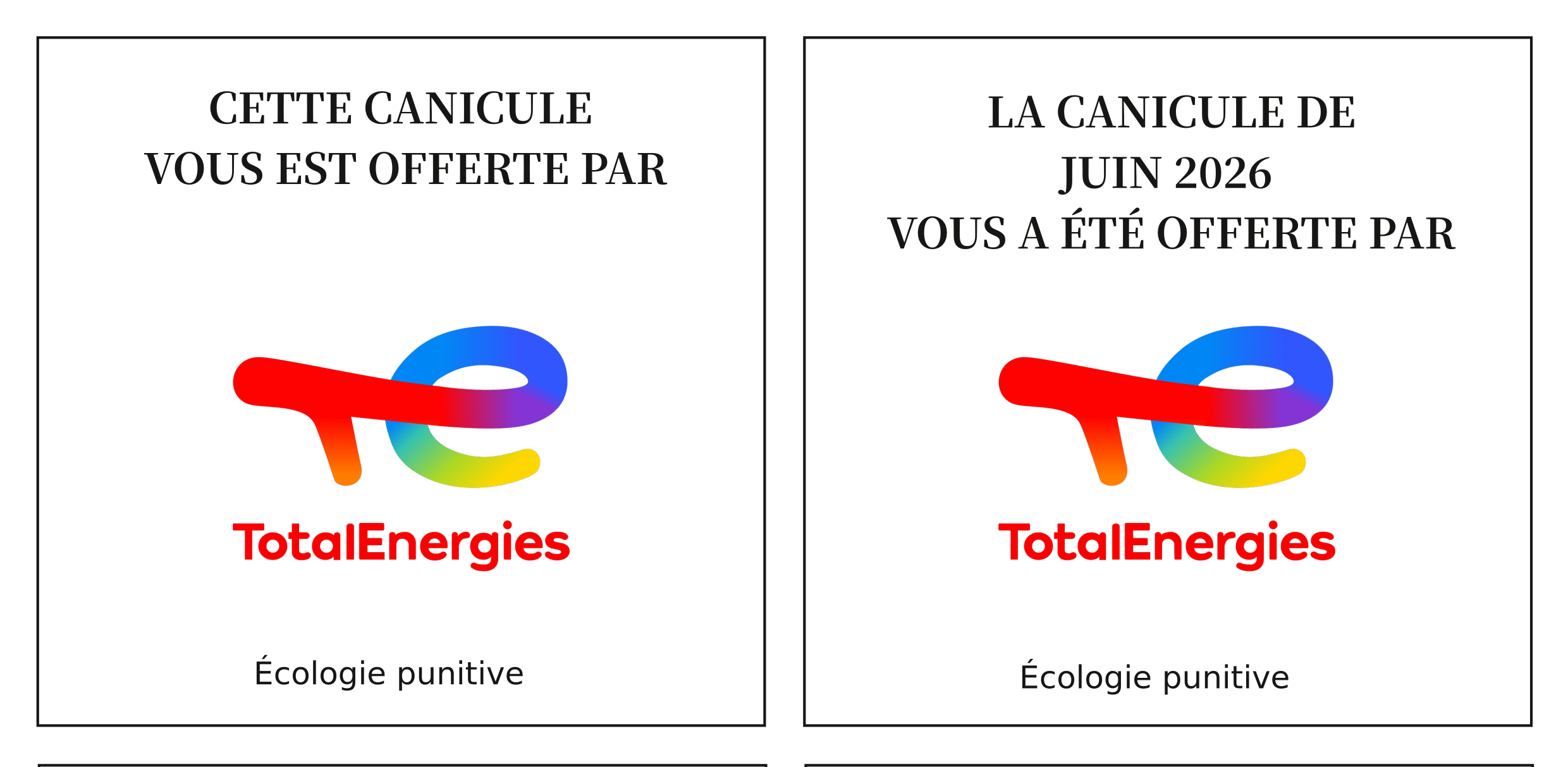
Il a également fait les stickers pour celle de mai :

Et il prévoit déjà celle de juillet :
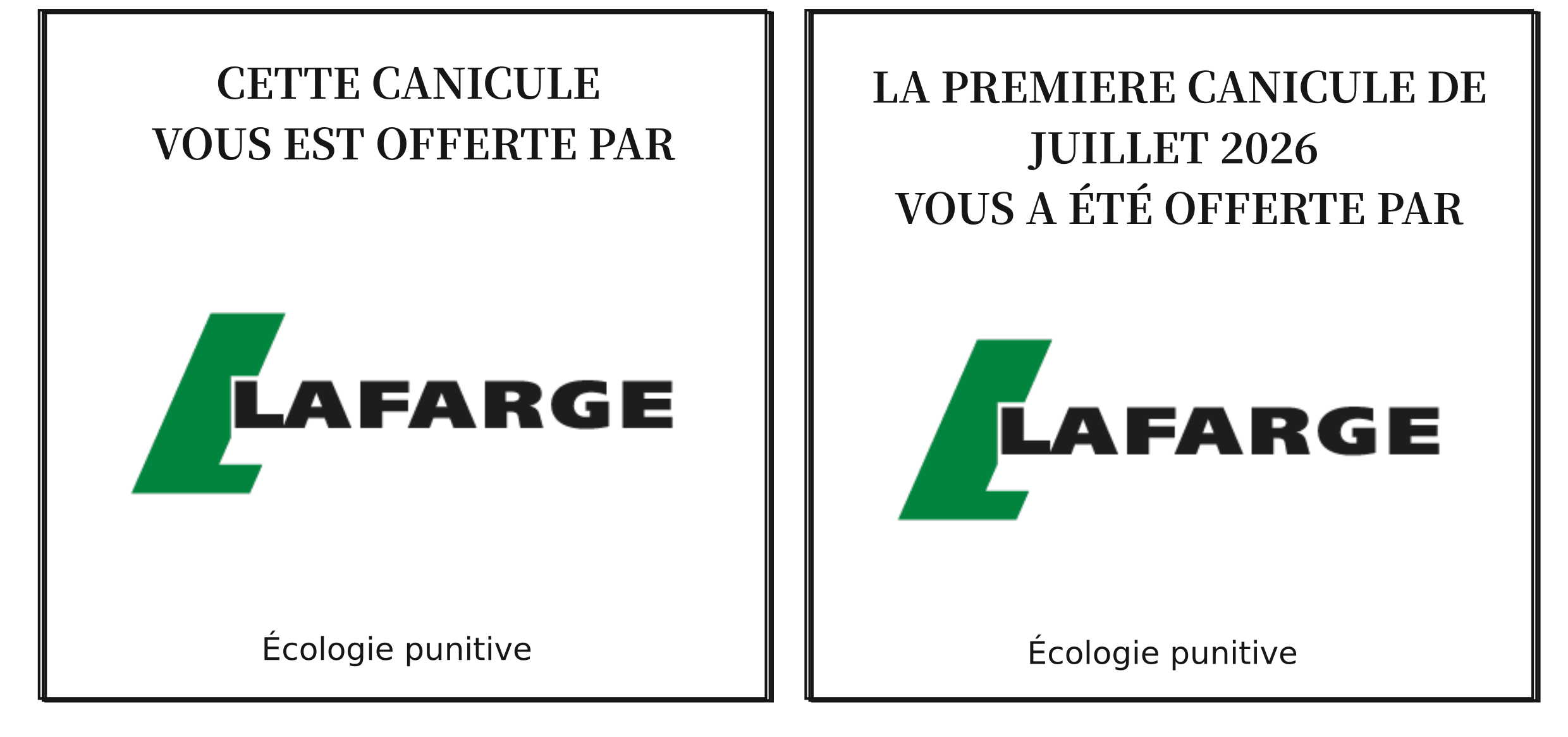
En 2026, TotalEnergies a clairement écrasé Bolloré. Lafarge pourra-t-elle tenir le niveau ? Rien n’est moins sûr, les supporters lancent déjà les paris.
Pour les prochains stickers, vous pouvez suivre Patlabar sur Mastodon:
PS: À propos de sponsor, l’équipe cycliste Israël-Startup Nation avait, en 2025, subit les foudres du public sur la Vuelta, entraînant son retrait de l’épreuve et le changement de sponsor pour 2026. Je me demande si on verra un jour des protestations similaires pour des équipes comme TotalEnergie ou Uno-X, qui sponsorisent le vélo en vendant de l’essence.
À propos de l’auteur :
Je suis Ploum et je viens de publier Bikepunk, une fable écolo-cycliste entièrement tapée sur une machine à écrire mécanique. Pour me soutenir, achetez mes livres (si possible chez votre libraire) !
Recevez directement par mail mes écrits en français et en anglais. Votre adresse ne sera jamais partagée. Vous pouvez également utiliser mon flux RSS francophone ou le flux RSS complet.
- Persos A à L
- Carmine
- Mona CHOLLET
- Anna COLIN-LEBEDEV
- Julien DEVAUREIX
- Cory DOCTOROW
- Lionel DRICOT (PLOUM)
- EDUC.POP.FR
- Marc ENDEWELD
- Michel GOYA
- Hubert GUILLAUD
- Gérard FILOCHE
- Alain GRANDJEAN
- Hacking-Social
- Samuel HAYAT
- Dana HILLIOT
- François HOUSTE
- Tagrawla INEQQIQI
- Infiltrés (les)
- Clément JEANNEAU
- Paul JORION
- Christophe LEBOUCHER
- Michel LEPESANT
- Persos M à Z
- Henri MALER
- Christophe MASUTTI
- Jean-Luc MÉLENCHON
- MONDE DIPLO (Blogs persos)
- Richard MONVOISIN
- Corinne MOREL-DARLEUX
- Timothée PARRIQUE
- Thomas PIKETTY
- VisionsCarto
- Yannis YOULOUNTAS
- Michaël ZEMMOUR
- LePartisan.info
- Numérique
- Thomas BEAUFILS
- Blog Binaire
- Christophe DESCHAMPS
- Dans les Algorithmes
- Louis DERRAC
- Olivier ERTZSCHEID
- Olivier EZRATY
- Framablog
- Fake Tech (C. LEBOUCHER)
- Romain LECLAIRE
- Tristan NITOT
- Francis PISANI
- Irénée RÉGNAULD
- Nicolas VIVANT
- Collectifs
- Arguments
- Scientifiques en Rebellion
- Bondy Blog
- Dérivation
- Économistes Atterrés
- Dissidences
- Mr Mondialisation
- Palim Psao
- Paris-Luttes.info
- Rojava Info
- X-Alternative
- Créatifs / Art / Fiction
- Nicole ESTEROLLE
- Julien HERVIEUX
- Alessandro PIGNOCCHI
- Laura VAZQUEZ
- XKCD